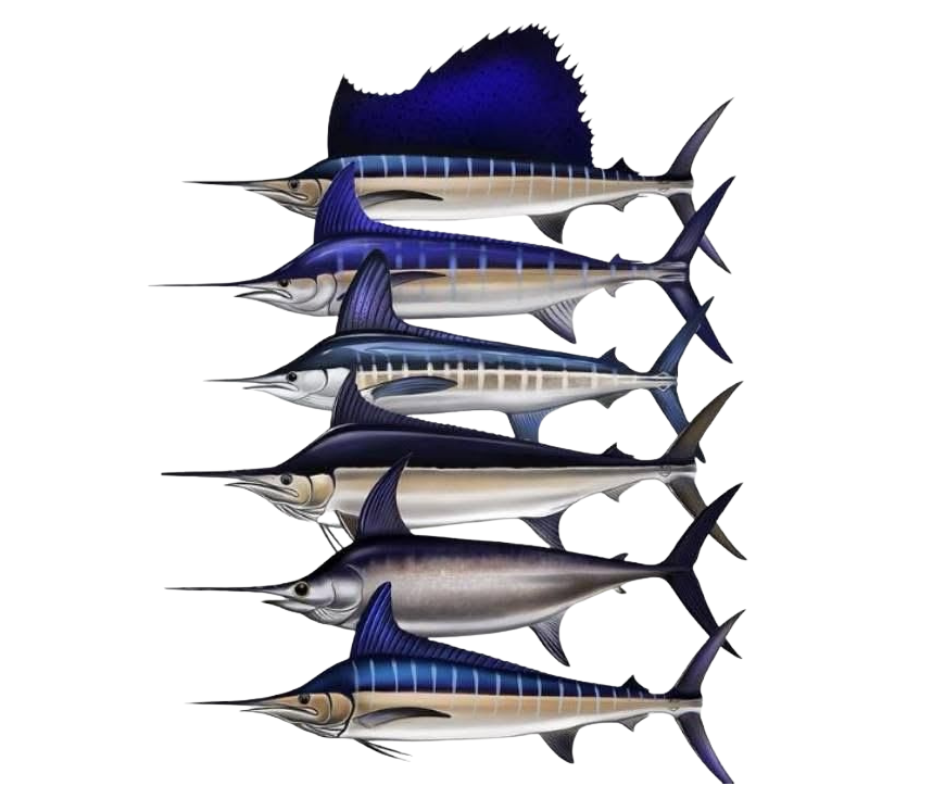
Learn how to identify billfish species through key physical traits, behavior, and environment. From subtle differences to unmistakable features, this guide helps you confidently distinguish species in any setting.
The key features used to distinguish billfish species across environments, life stages, and encounters.
Location
Where a fish is found can be one of the first clues to identification. Certain billfish species are more common in specific regions, water temperatures, and depths. While ranges can overlap, understanding geographic patterns helps narrow down likely species quickly.
Fins
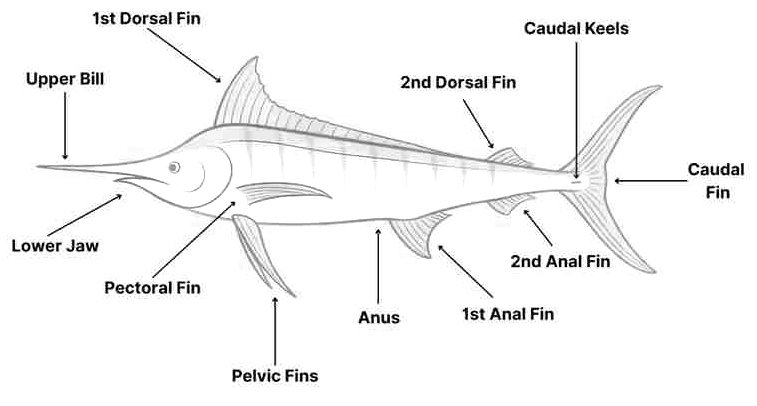
Fin shape, size, and structure are among the most reliable visual identifiers. Differences in dorsal fin height and shape, pectoral fin length, and the presence or absence of pelvic fins can clearly separate species, especially when observed boatside or underwater.
Body Size
Overall size and body profile provide important context. Some species are more slender and streamlined, while others appear heavier and more robust. Bill length, body depth, and tail shape all contribute to distinguishing one species from another.
Species Identification
Anatomy
BoDY
FinS
Species Identification
Billfish Habitat
Billfish inhabit warmer oceanic waters, though their exact range depends on the species. They are pelagic, meaning they spend most of their lives in the open ocean, far from coastlines. Often, they are found near the surface but can dive to significant depths in search of prey.
Want to keep track of current billfish activity?
Join our tag and release program to keep up to date with billfish migration patterns, catches, and more.
First lobe of the first dorsal fin is less than body depth
Second dorsal fin origin is behind second anal fin origin
Double keel present
*Modified from Collette & Graves 2019
Boatside
Blue Marlin
Boatside
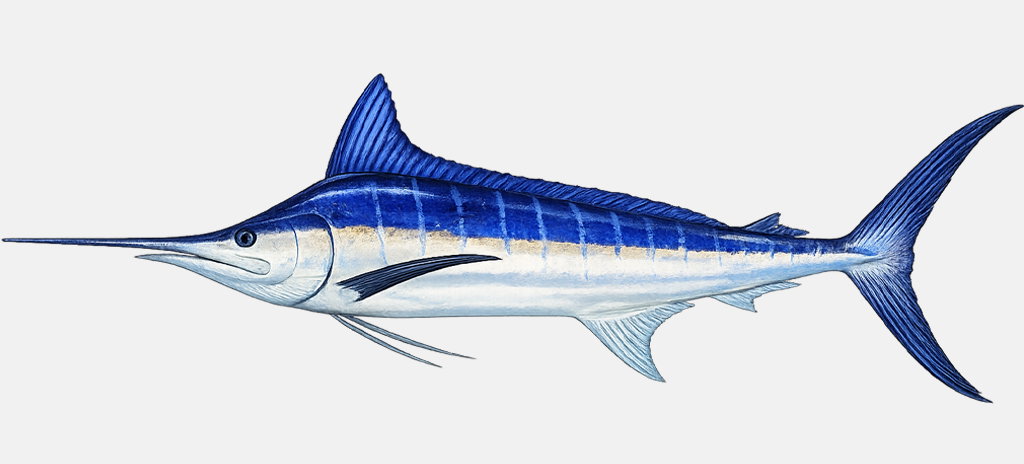
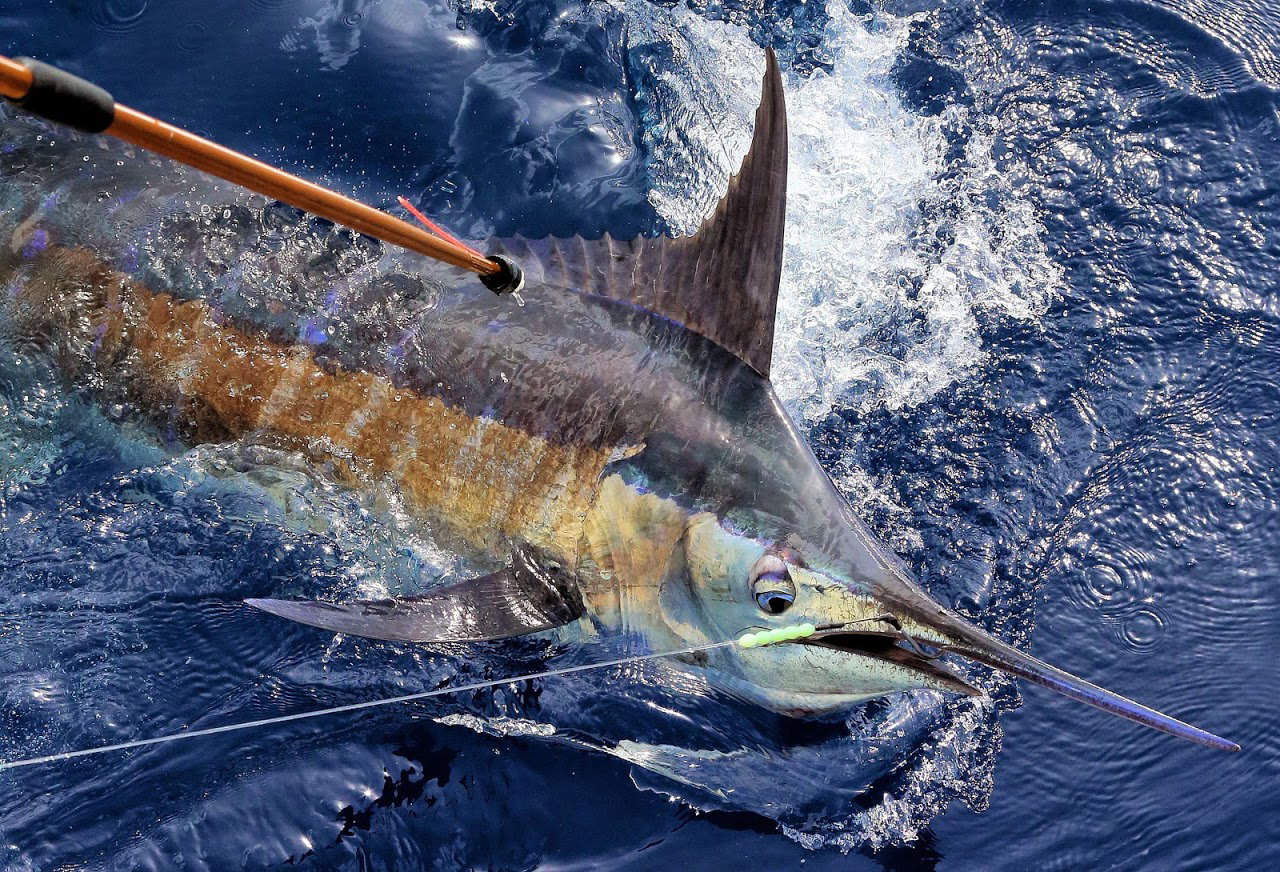
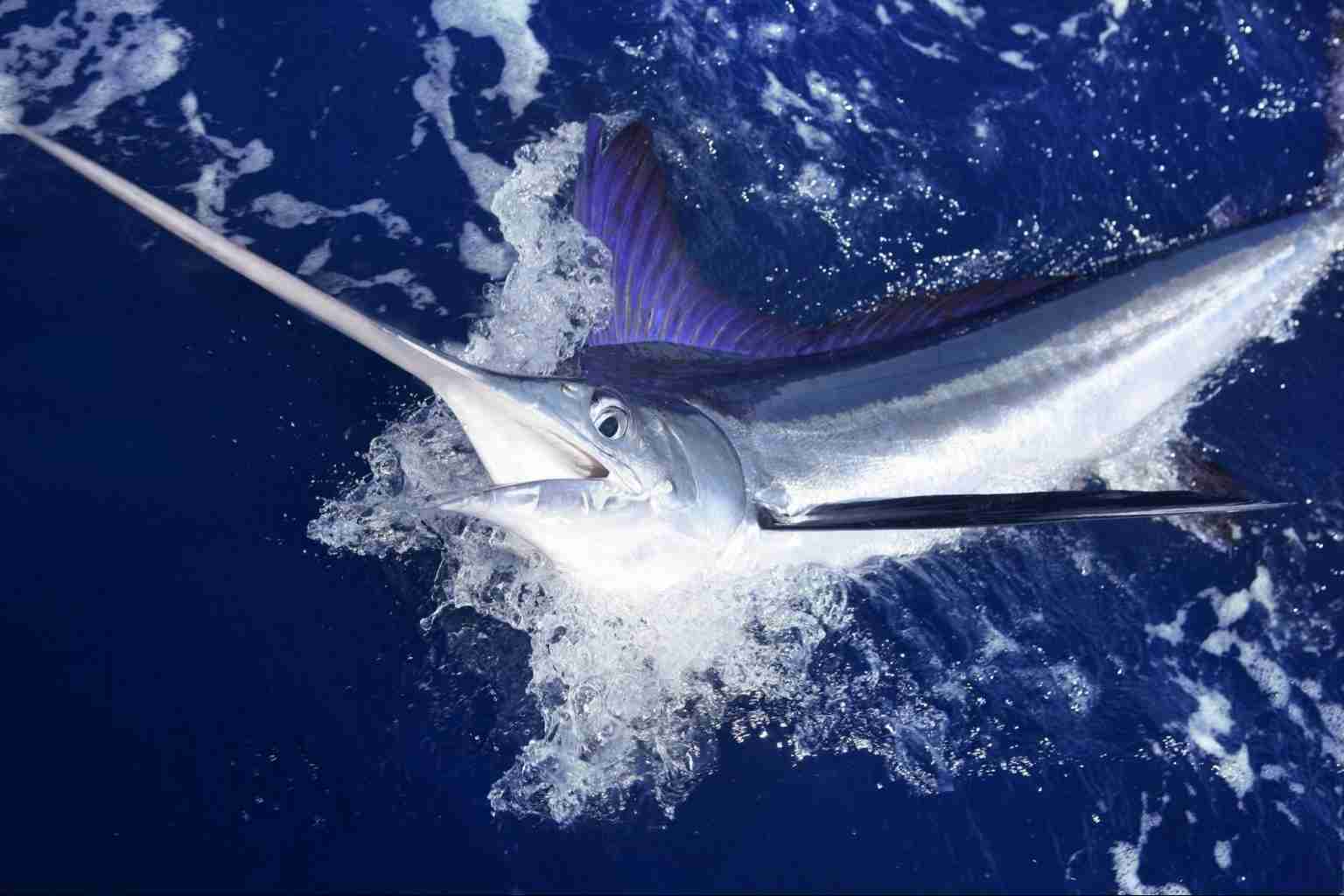
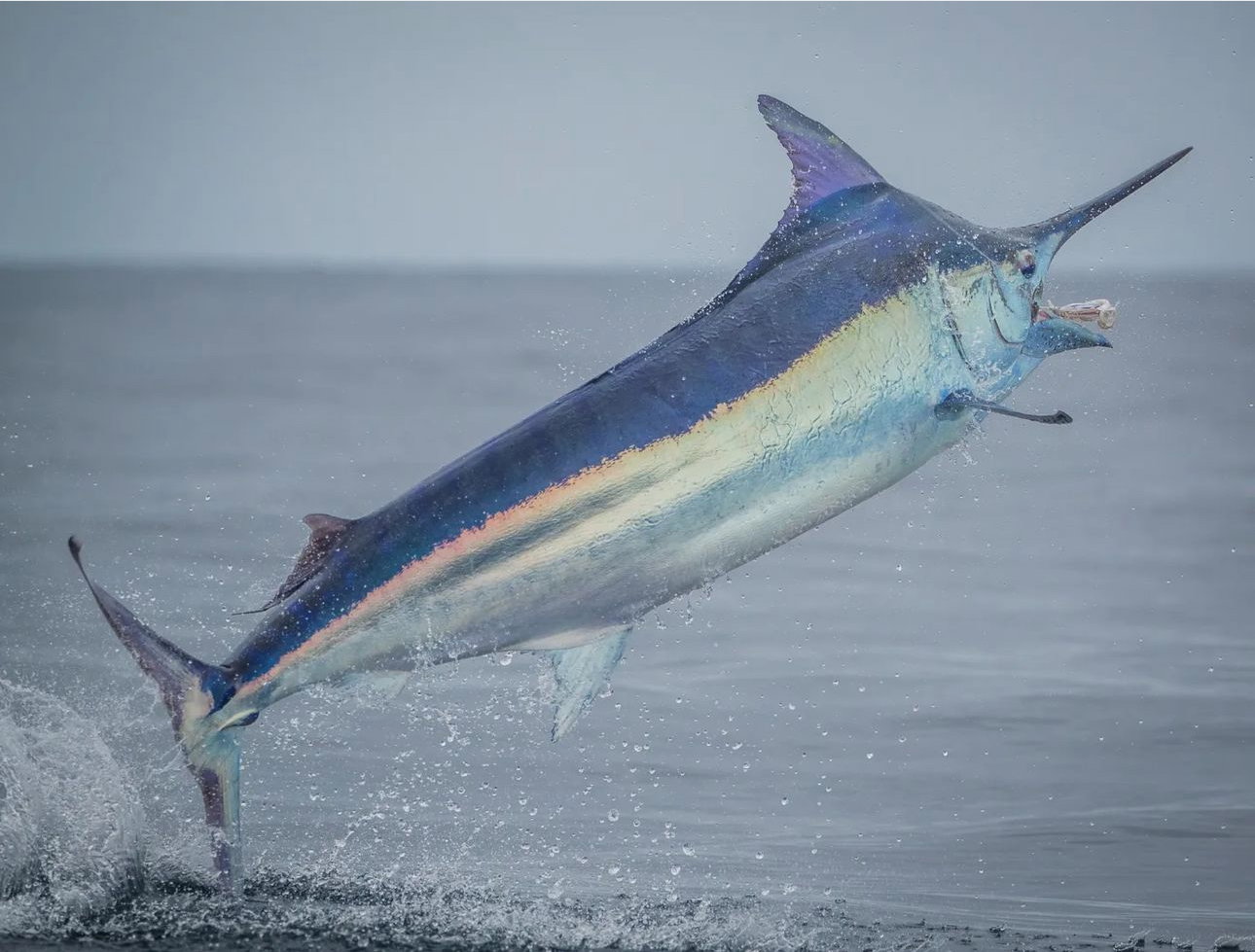
When a blue marlin surfaces near the boat, its distinctive features become more apparent. Look for the striking, light-colored, vertical stripes illuminating its body, especially under sunlight or when the fish is excited. Notice its pointed dorsal fin, which fans out prominently along its back to roughly midway down its body, and its pectoral fins, capable of folding flat against its sides.
In Action
Blue Marlin
In Action
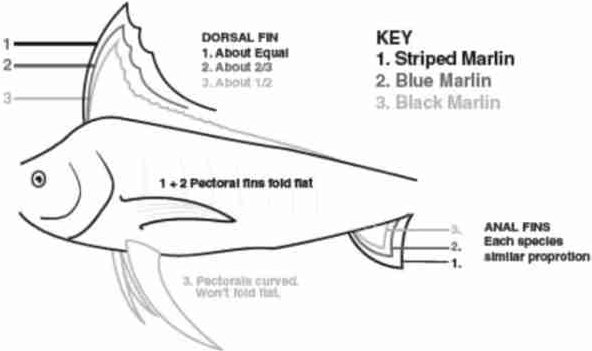
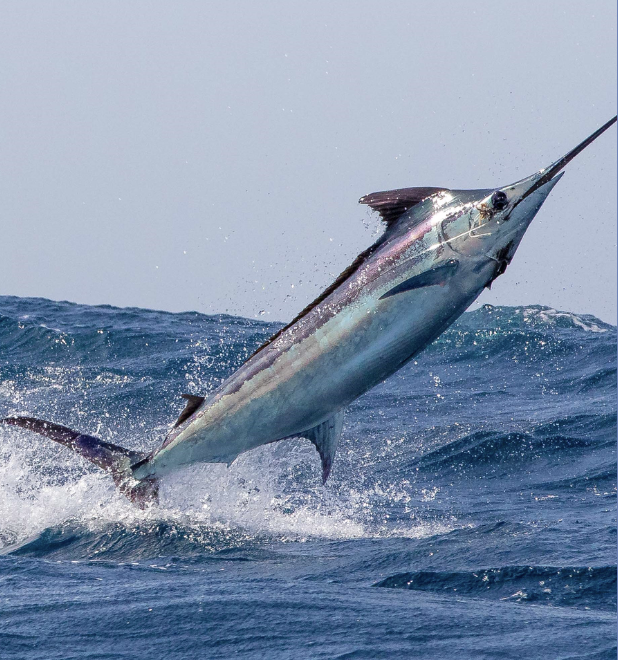
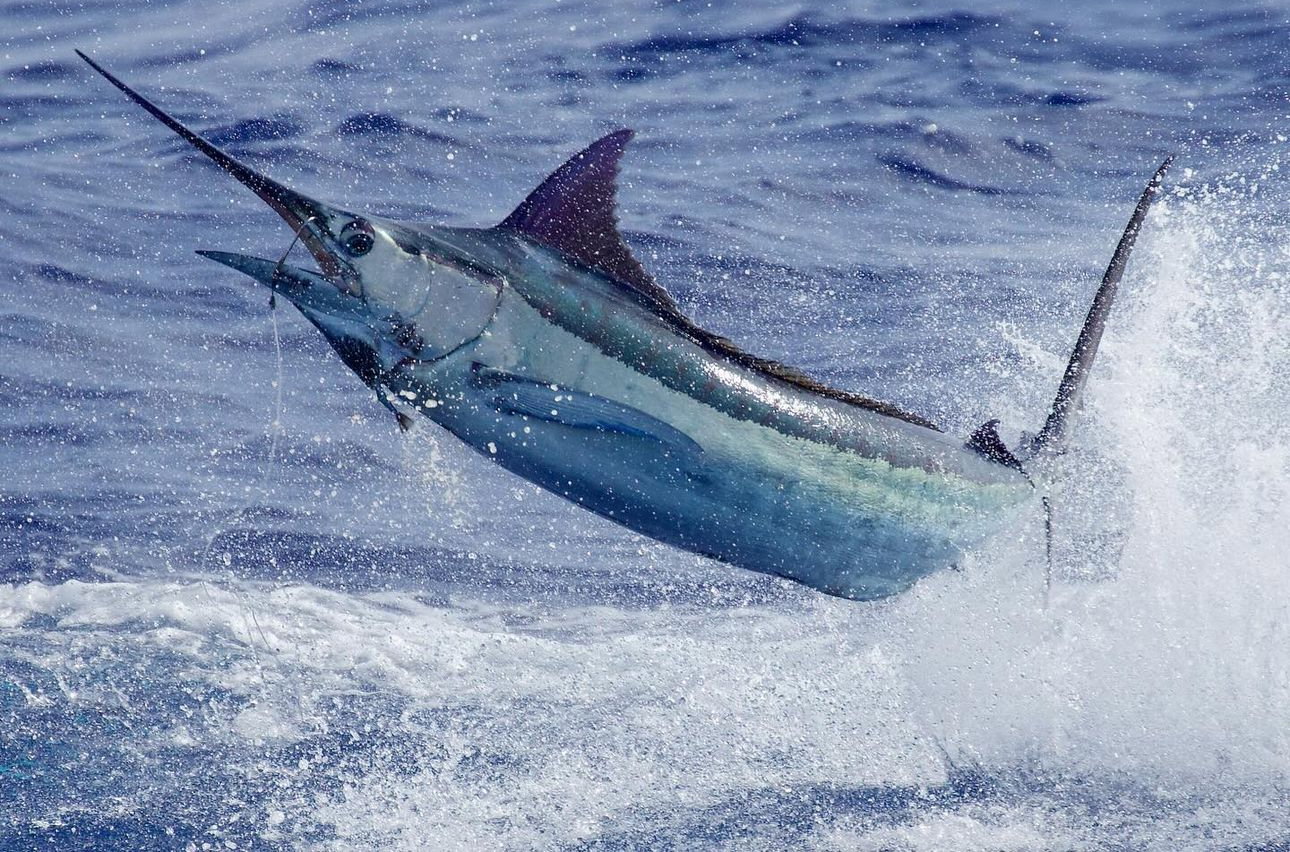
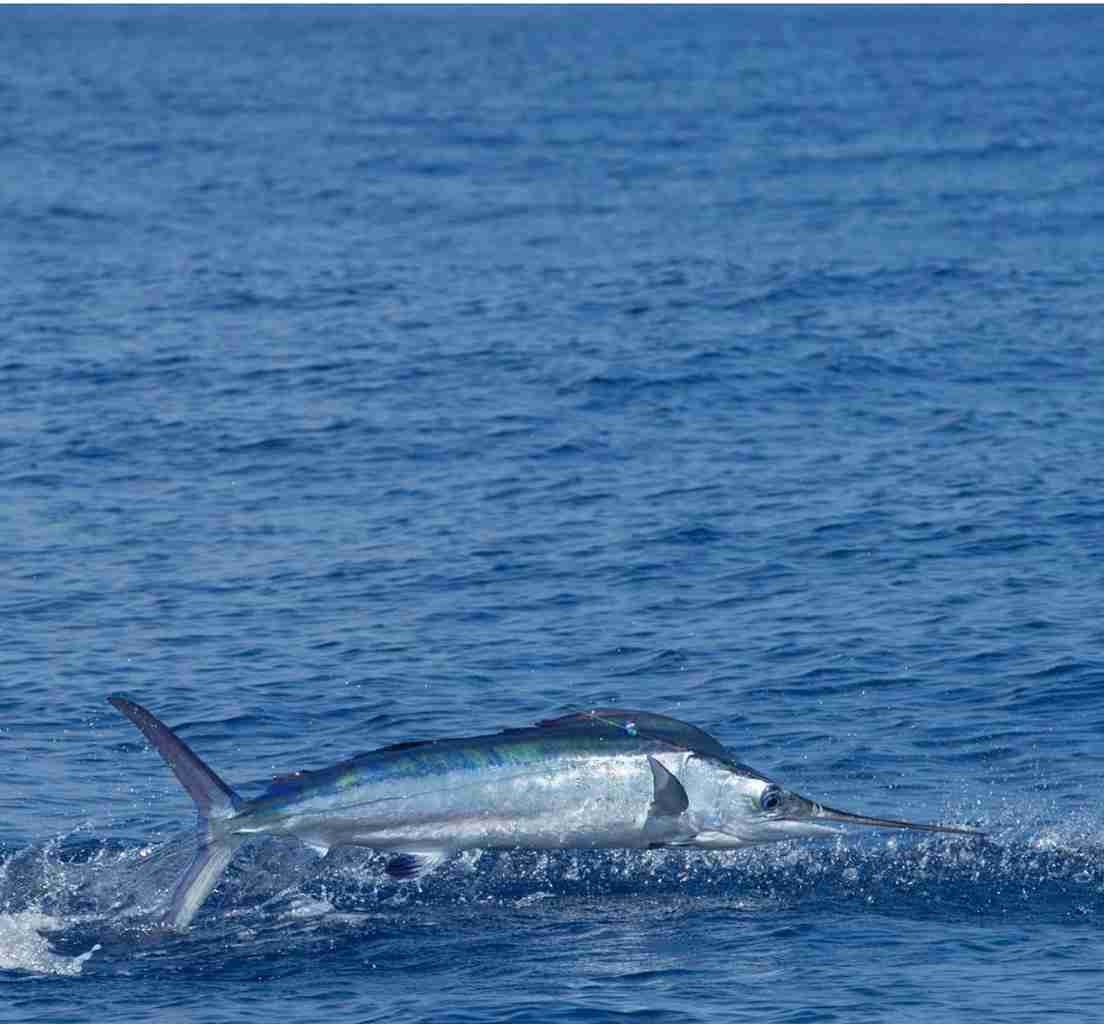
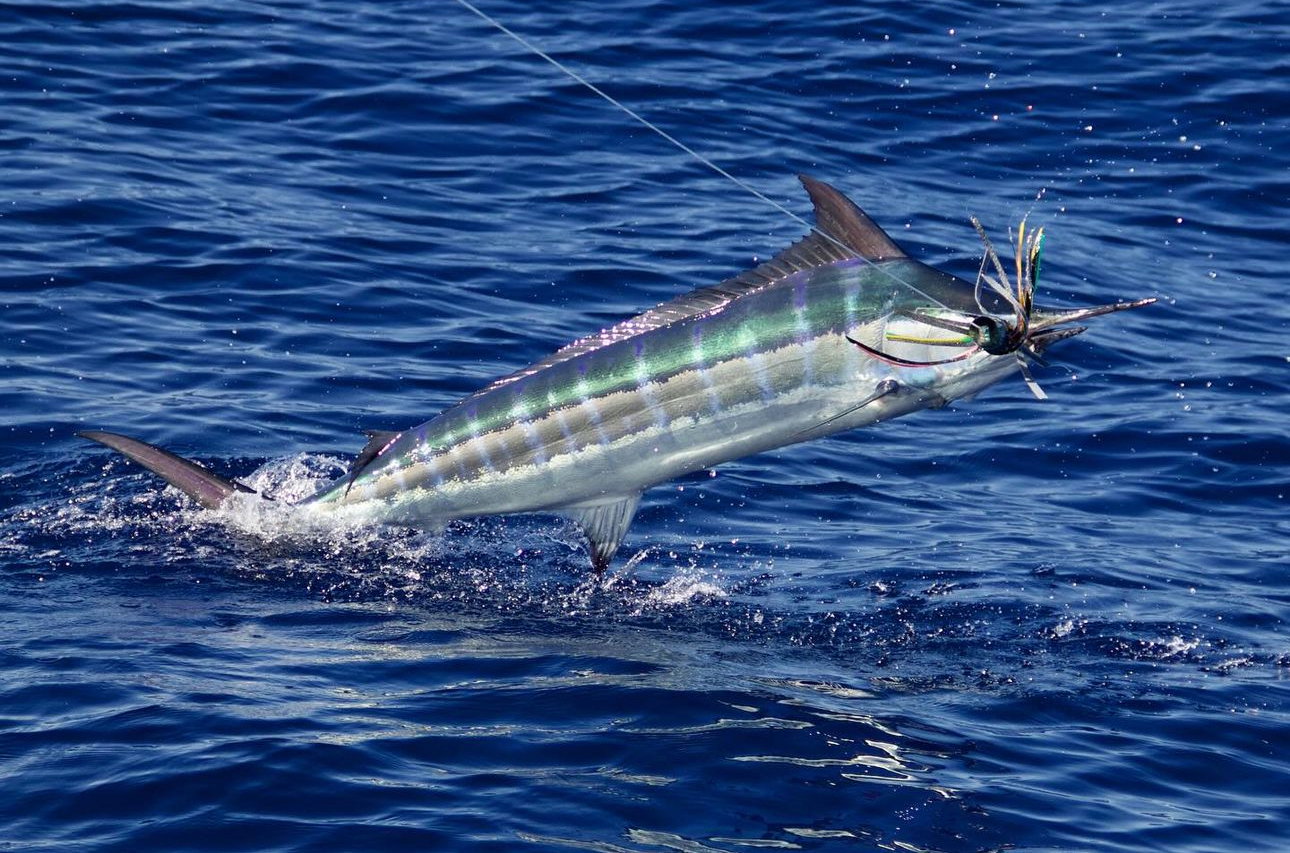
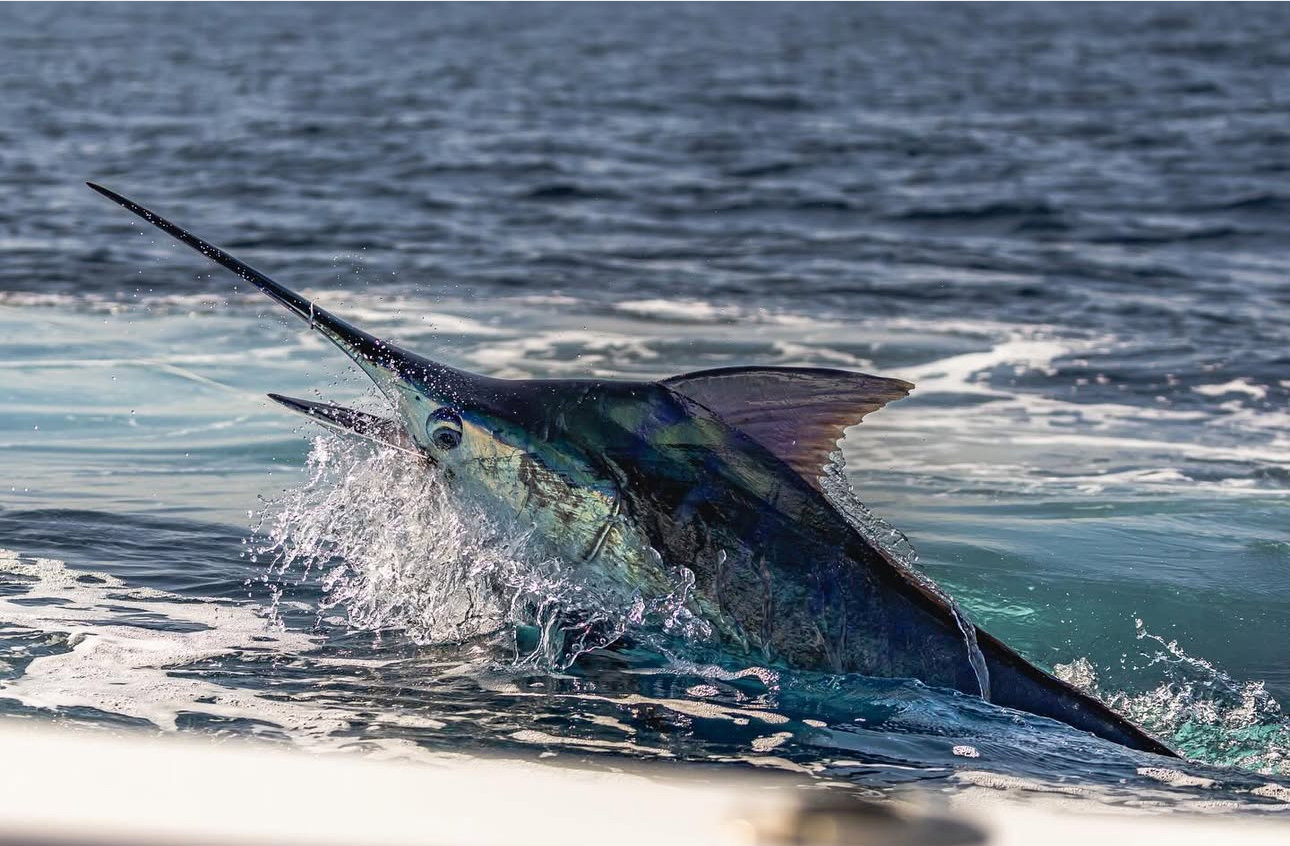
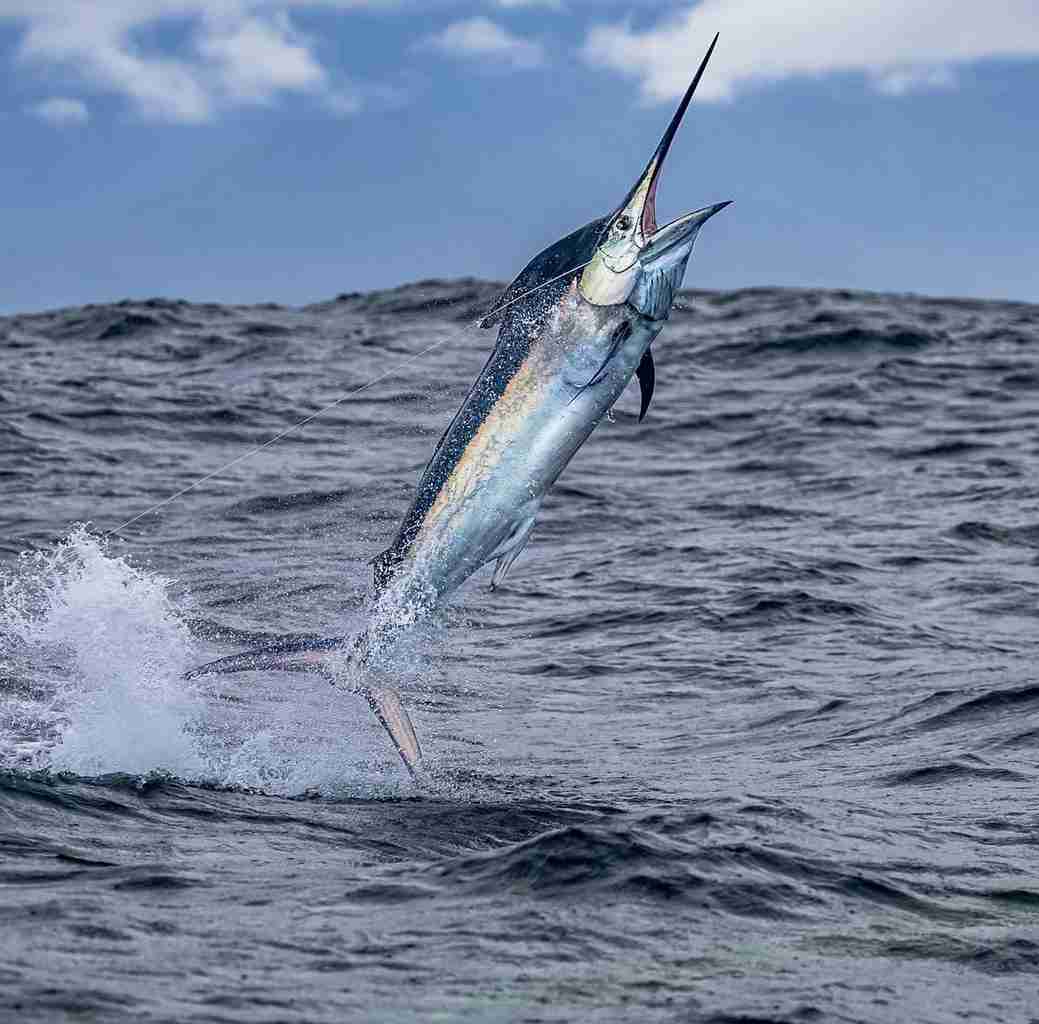
Look for high, arching jumps or violent headshakes where the entire body twists above the surface. If close enough, faint vertical stripes may be visible along the sides, glowing with an iridescent lavender or blue tone when the fish is excited, such as during a hook-up. The crescent-shaped caudal (tail) fin is robust and distinctive, often whipping the water as the fish attempts to escape. One behavioral clue is how they jump: Blue Marlin tend to pick a direction and cover ground when they leap, while Black Marlin usually jump straight up and land back in the same spot. Physically, black marlin have a slightly stubbier bill, shorter dorsal fin relative to their body size, and rigid, sickle-shaped pectoral fins that do not fold back against their body.
Underwater
Blue Marlin
Underwater
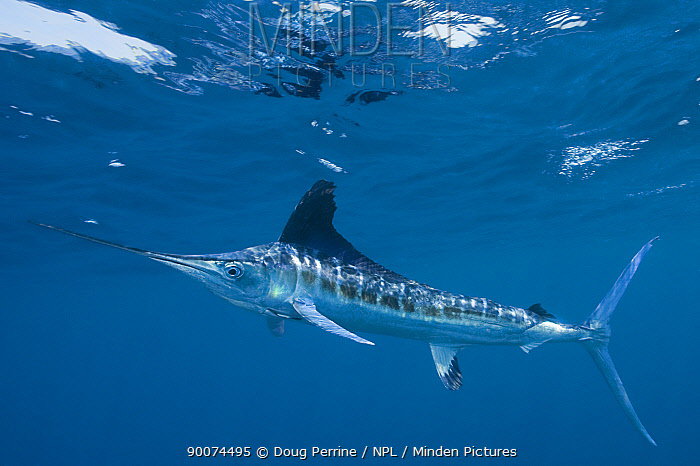
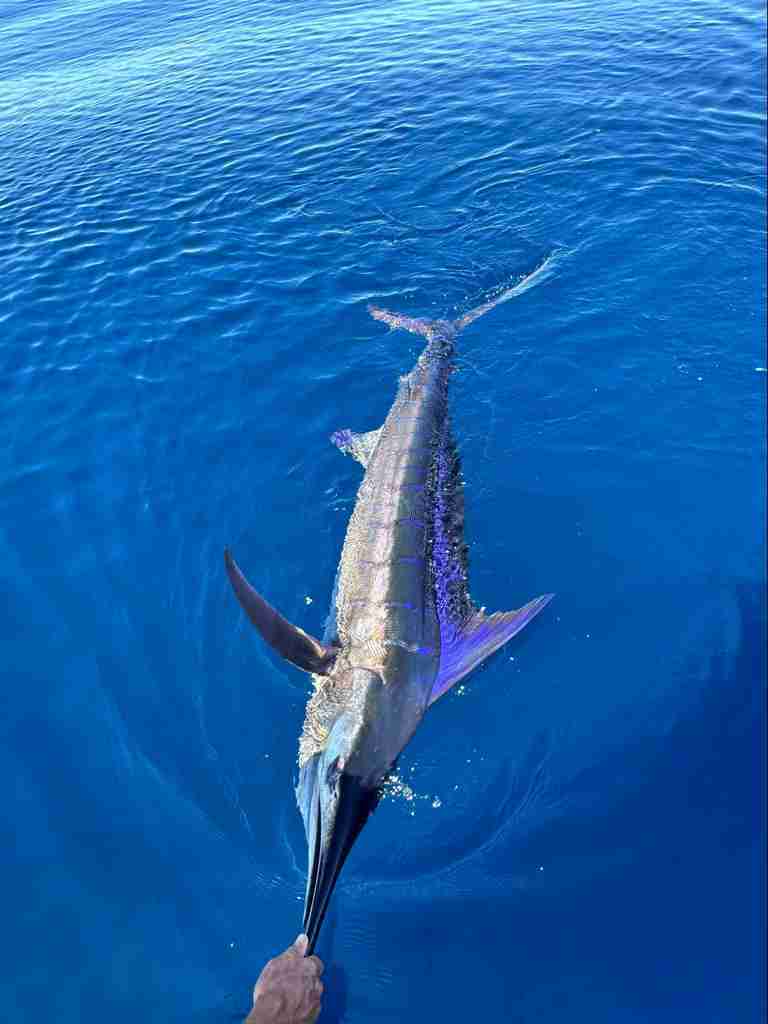
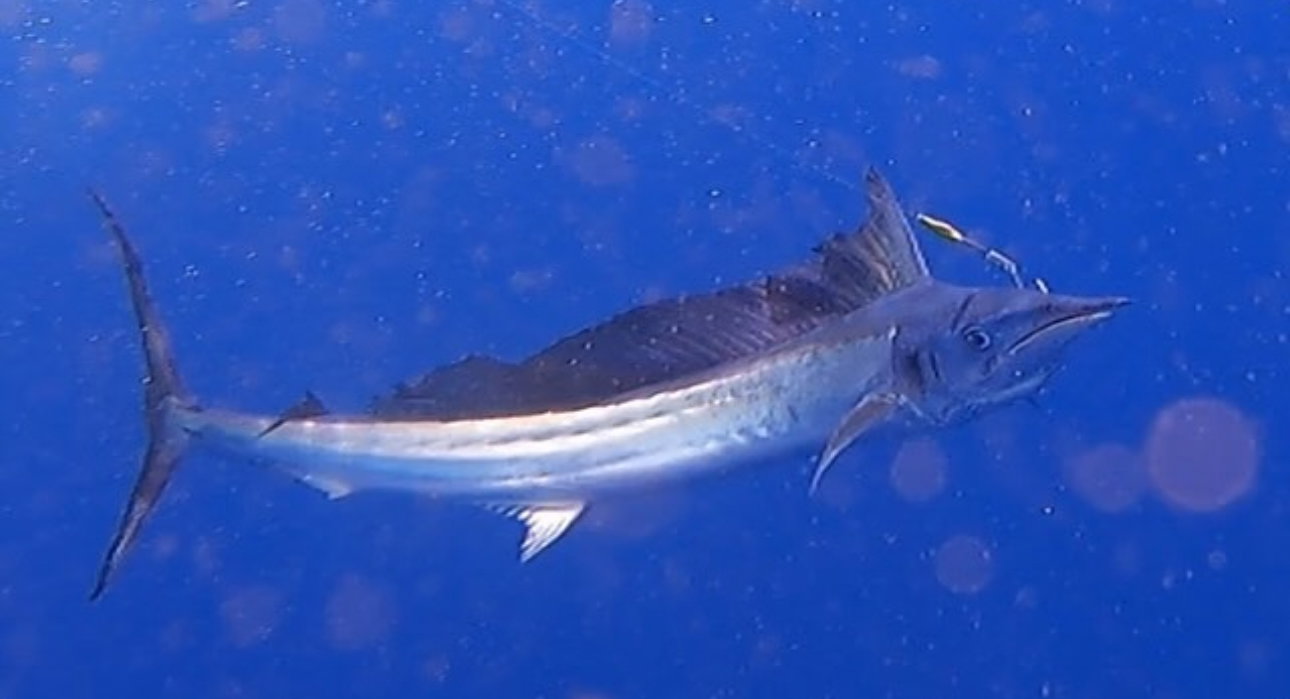
The dorsal and pectoral fins, which may lie flat when the fish is stressed or out of the water, are often erect or slightly spread during swimming. The vibrant cobalt-blue back appears iridescent, blending seamlessly with the deep ocean waters for camouflage. Its vertical stripes, which can sometimes fade under stress, are most visible in calm, relaxed swimming conditions, glowing lavender or light blue.
Early Life
Blue Marlin
Early Life
Juvenile blue marlin lack the elongated bill that develops later in life. They have tiny, sharp “baby teeth” lining their jaws, an oversized dorsal fin that appears disproportionately large compared to their body, and faint vertical striping. As they grow, the dorsal fin becomes more proportionate, and the bill gradually elongates, resembling the adult form.
Adult
Blue Marlin
Adult
Adult blue marlin are large, powerful fish with a streamlined, torpedo-shaped body. They have a long, spear-like bill, cobalt-blue backs that fade into silvery-white bellies, and faint vertical stripes on their sides. Their dorsal fin is tall but proportionate, and their crescent-shaped tail fin provides powerful propulsion.
In the Atlantic, identification is more straightforward. Blue marlin in this region can grow up to 14 feet long and weigh over 2,000 pounds. Additionally, any marlin over 300 pounds in the Atlantic is automatically a blue marlin, as white marlin and spearfish do not grow that large. Blue marlin also have distinctive pointed dorsal, pectoral, and anal fins, which are key indicators. For smaller specimens, closer examination of these fins usually confirms the identification.
In the Pacific, distinguishing a blue marlin is more challenging due to the presence of black marlin, which can reach similar sizes. Pacific blue marlin can grow over 12 feet long and weigh up to 2,000 pounds, with some individuals reaching 15 feet but only weighing up to 1,500 pounds.
Another identification challenge in the Pacific is distinguishing blue marlin from striped marlin. While both species can have pointed fins, the key difference lies in the dorsal fin. Striped marlin have a significantly larger dorsal fin, approximately one-third to one-half bigger in proportion to their body size compared to blue marlin. Striped marlin also have larger pectoral fins compared to body size. This difference is a reliable way to differentiate the two species.
Mounted
Blue Marlin
Mounted
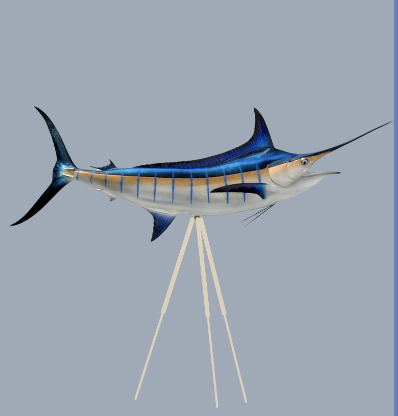
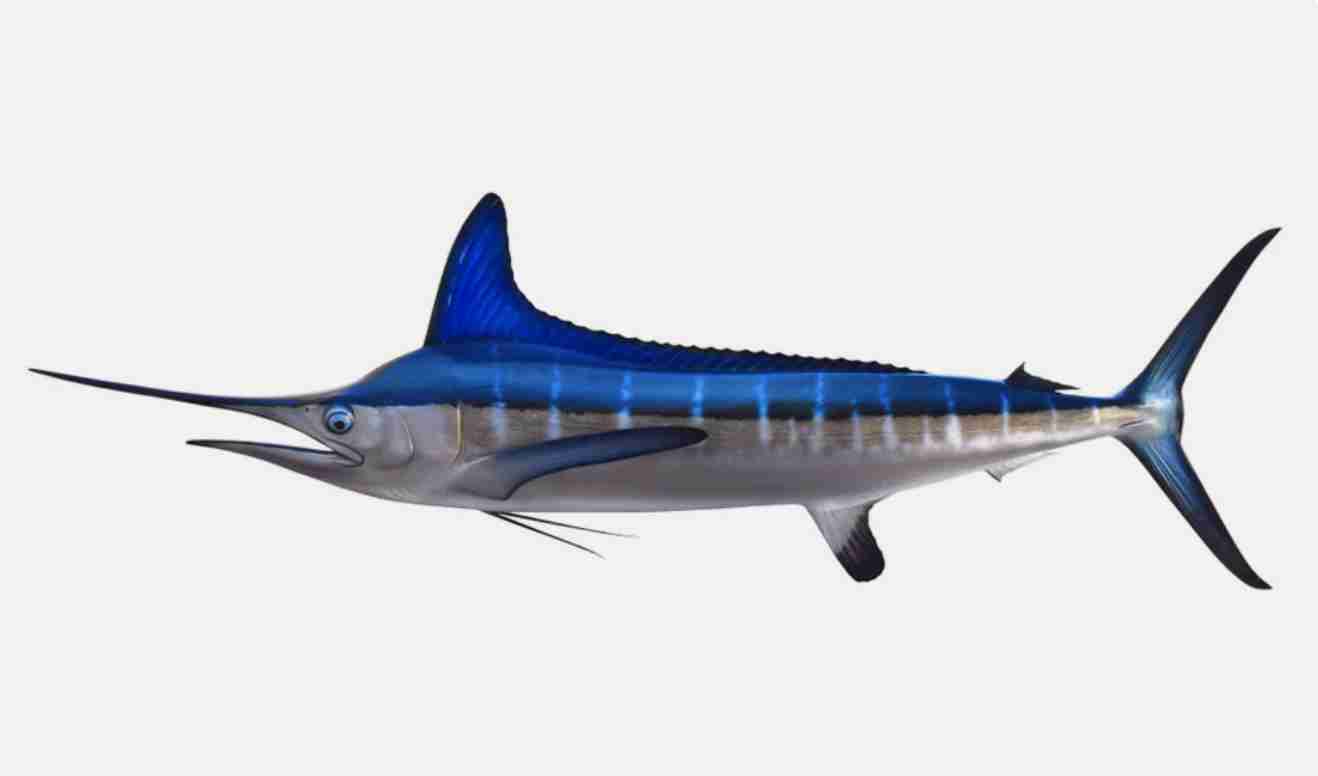
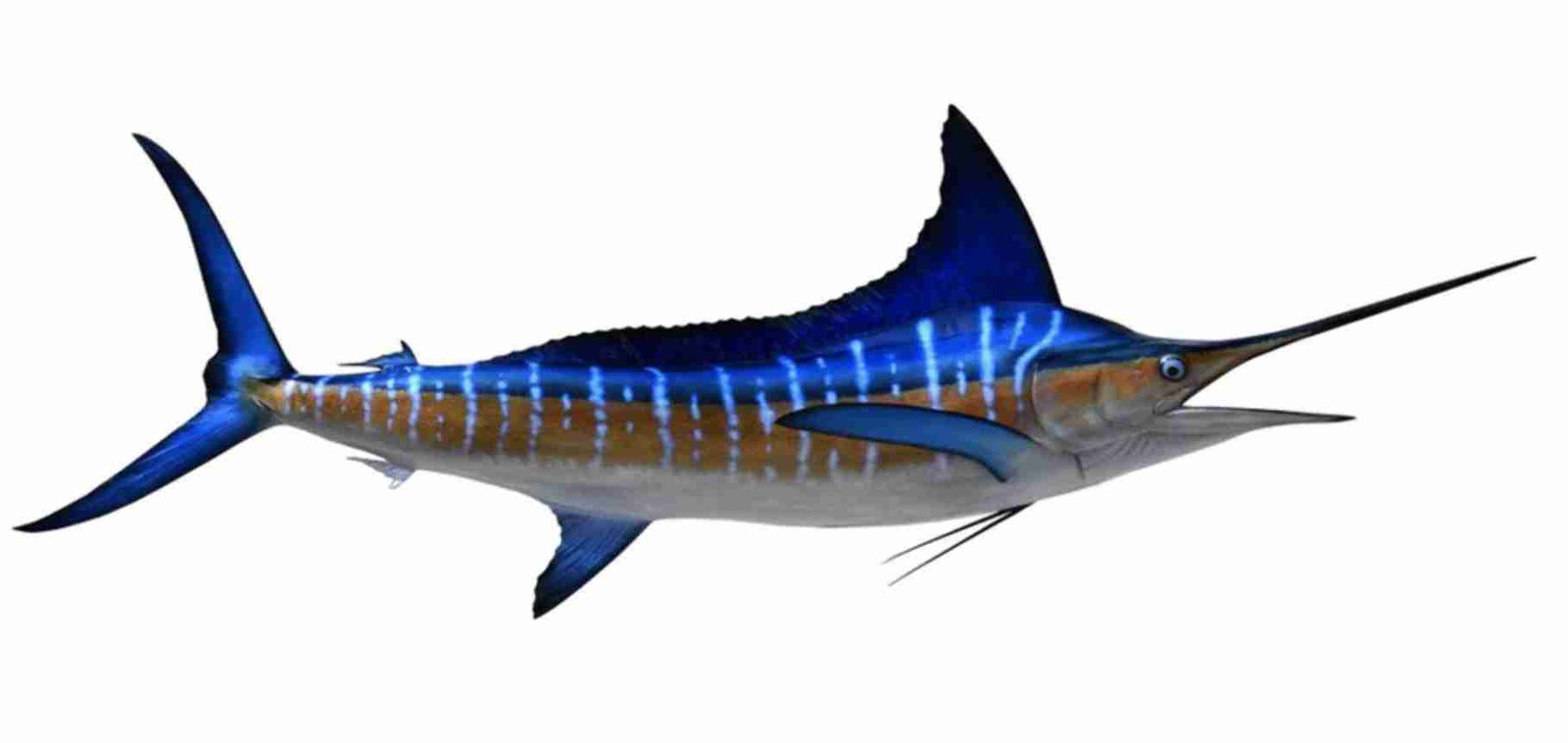
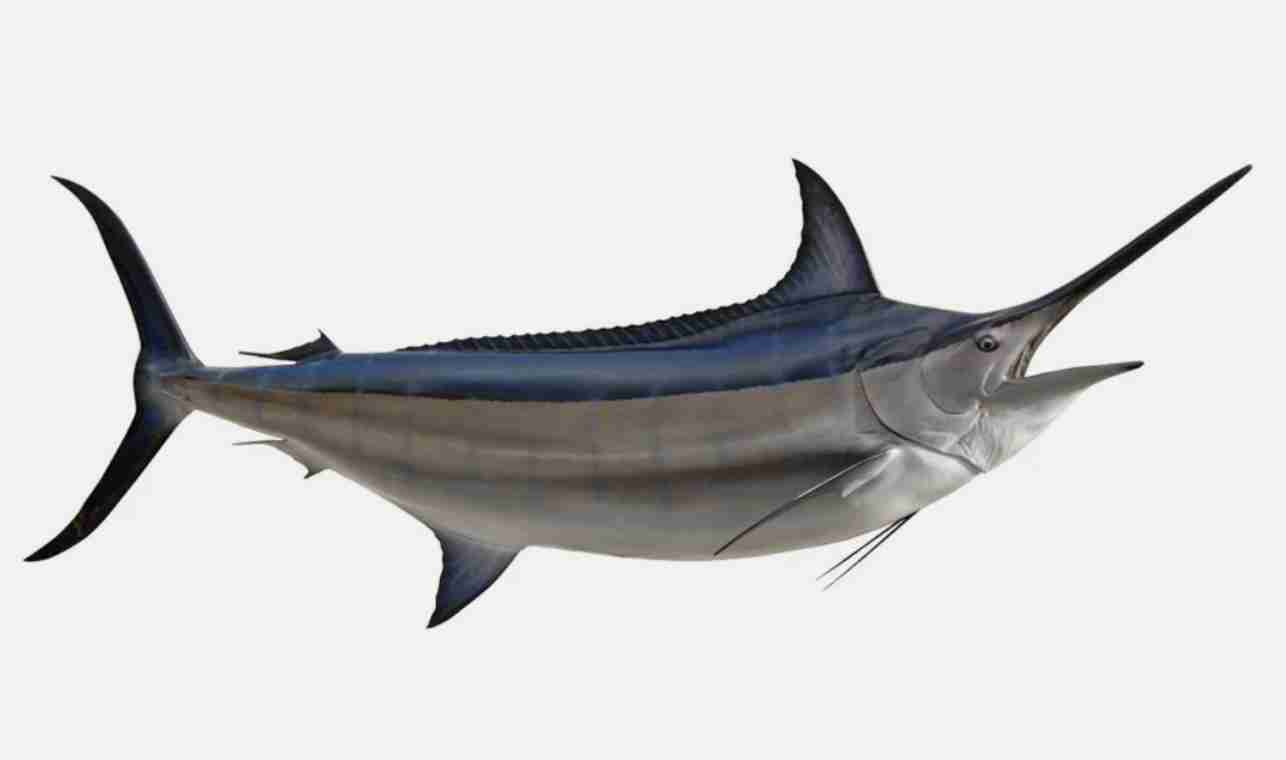
Mounted blue marlin showcase clear, distinct features with lifelike detail. The pectoral fins are folded back, and the dorsal fin is pointed and flared. Their vertical stripes are illuminated and bright, highlighting the fish’s natural coloration. These mounts emphasize key traits for educational and decorative purposes.
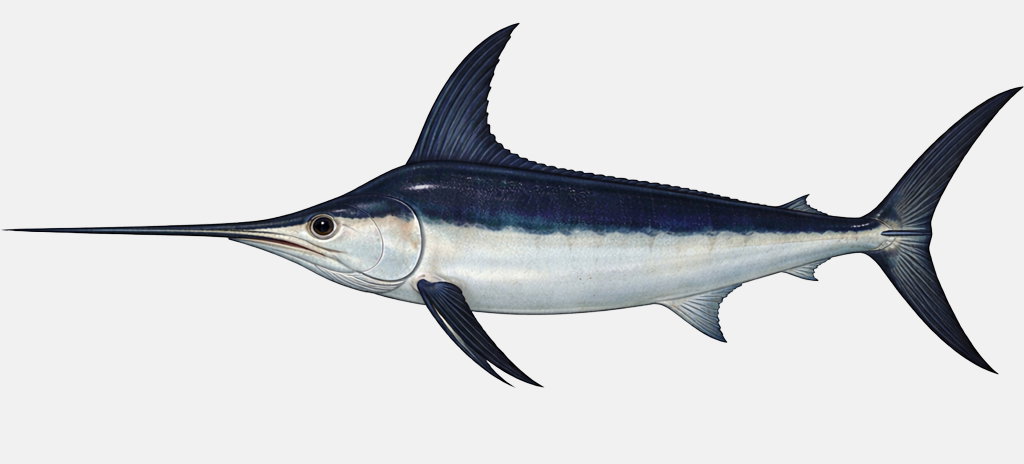
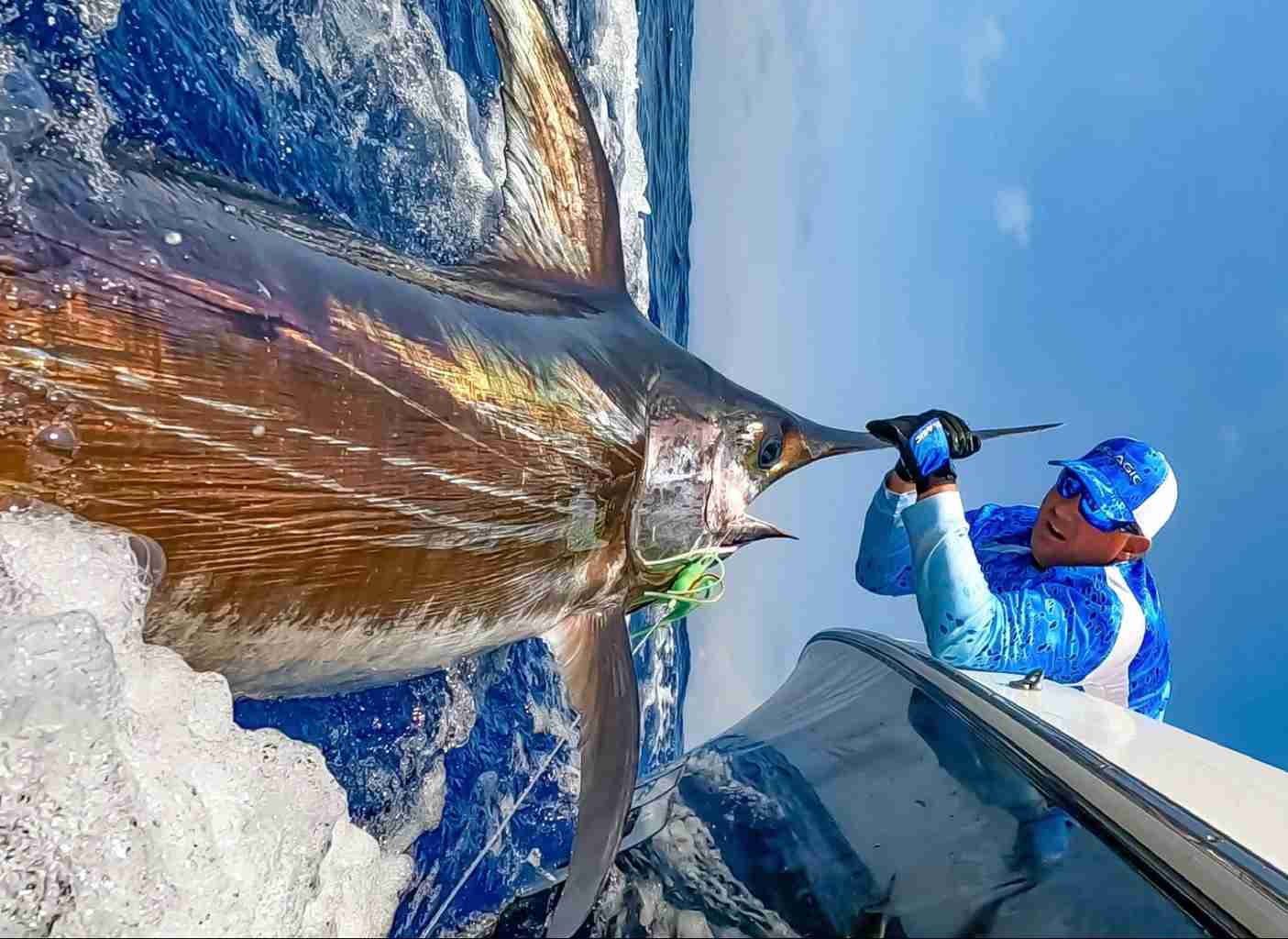
Boatside, a swordfish stands out immediately for its sheer bulk and unique silhouette. Unlike marlin or sailfish, swordfish lack a dorsal fin sail. Instead, they carry a tall, rigid first dorsal fin that rises sharply, like a blade, and then tapers back. Their long, flat, sword-like bill extends straight ahead, noticeably broader and flatter than a marlin’s rounded spear. Adult swordfish often exhibit a dark, chocolate-to-purple upper body that fades to silvery sides and belly. Their large, crescent tail and stocky build give them a heavier, more compact look when hauled close to the boat.
In Action
Swordfish
In Action
In action, swordfish are very different from the acrobatics of marlin or sailfish. They rarely leap repeatedly, instead using brute power to dive deep and stay down. Anglers often experience long, stubborn battles as swordfish sound hundreds of feet beneath the boat, using their weight and endurance rather than surface displays. When they do surface, it’s often in short bursts with violent headshakes, the flat bill slicing water rather than arcing high into the air.
Underwater
Swordfish
Underwater
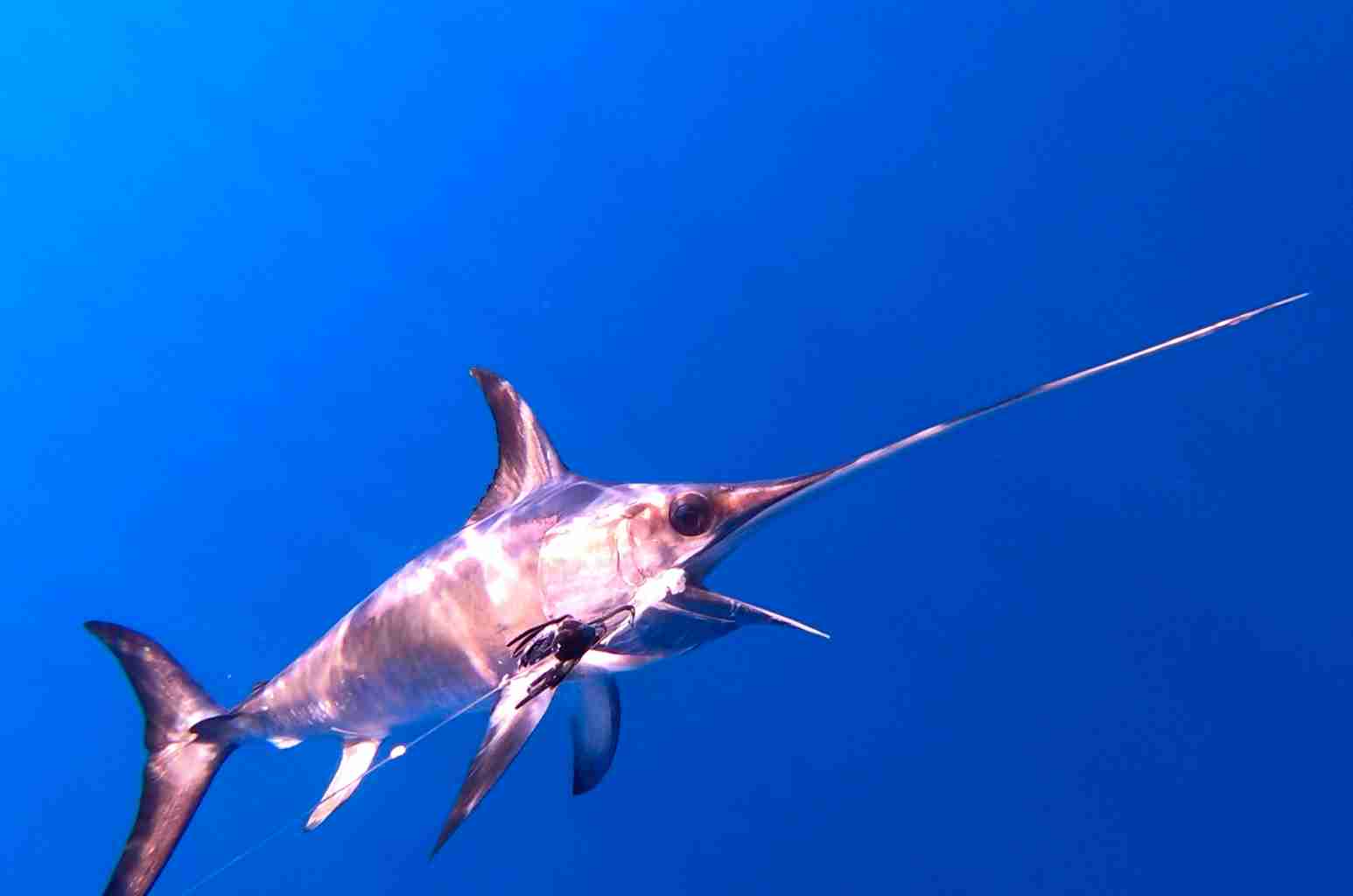
Underwater, swordfish can be identified by their distinctly broad, flat bill and large, round black eyes that are adaptations for hunting in low-light depths. Their tall, rigid first dorsal and crescent tail stand out in silhouette, and the absence of pelvic fins is another quick giveaway compared to marlin and sailfish. Adults are often seen cruising slowly, conserving energy in the cooler layers of the water column, their bodies reflecting a metallic sheen against the dark blue background.
Early Life
Swordfish
Early Life
Juvenile swordfish look strikingly different from adults. They carry both a first and second dorsal fin that appear taller and more sail-like, and they have long, threadlike pelvic fins that disappear as they mature. The young are more slender, with proportionally larger eyes and a shorter bill. These traits can sometimes cause early misidentification with small billfish species until the adult features develop.
Adult
Swordfish
Adult
As adults, swordfish are among the most distinctive of all billfish. They reach impressive sizes (200–600 lbs) with females growing far larger than males. Their defining traits are the long, flat “sword,” rigid sickle-shaped first dorsal, absence of pelvic fins, and crescent moon-shaped tail. Adults lose the juvenile “sail” features, taking on the heavy-bodied, streamlined profile built for deep-sea endurance hunting.
Mounted
Swordfish
Mounted
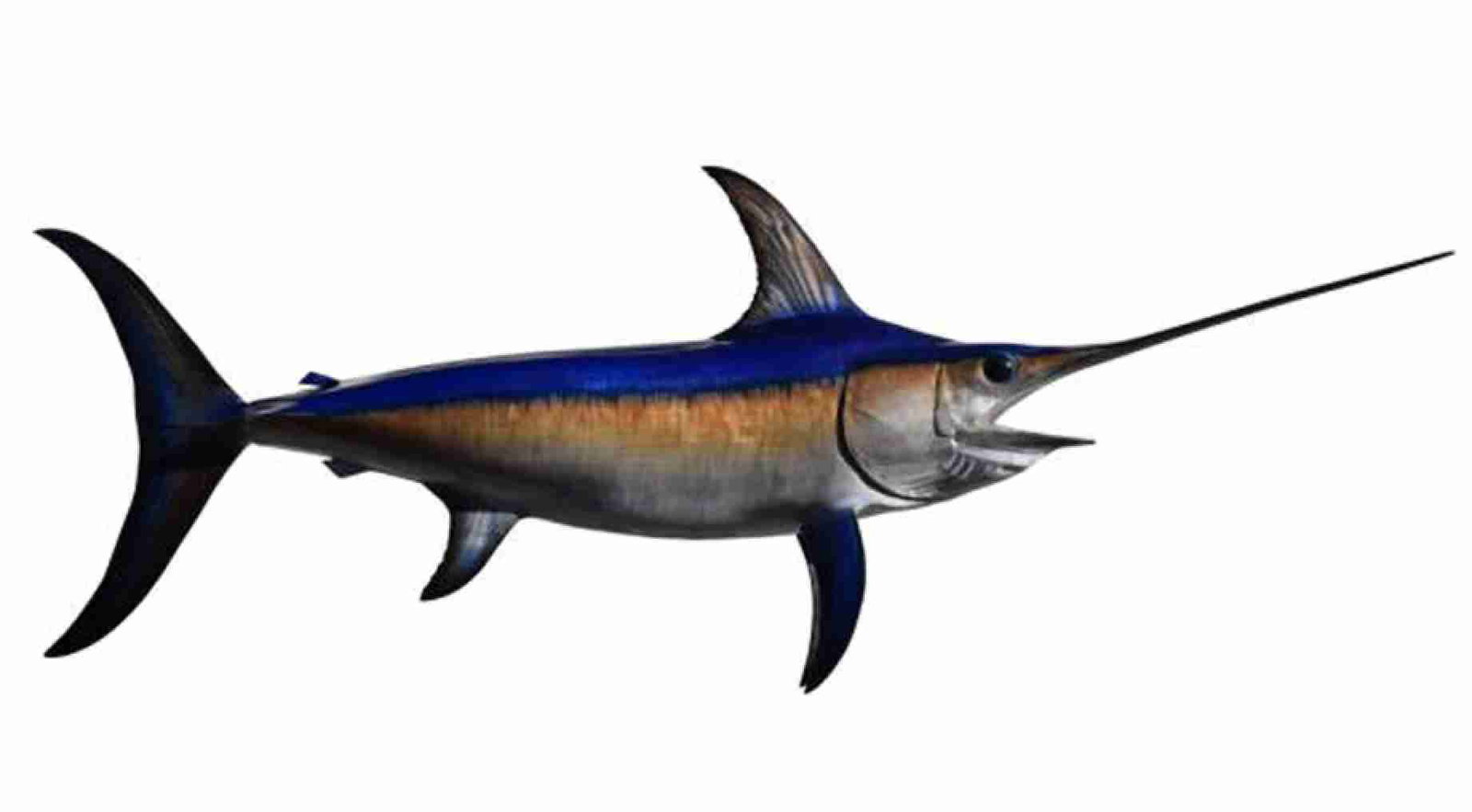
Mounted swordfish trophies highlight their unique build and distinguish them instantly from other billfish. The broad bill is always the centerpiece, noticeably flattened like a sword blade. The tall, curved first dorsal fin rises like a single banner near the head, and the absence of pelvic fins makes the body appear sleeker and more compact. Typical mounts effectively visualize the color shift from dark upper body to a silvery belly with the sweeping crescent tail completing their unmistakable profile.
When a sailfish is brought alongside the boat, its defining features become clearer:its large, sail-like dorsal fin, which is often raised when the fish is excited. The body exhibits iridescent blues, purples, and bronze hues, sometimes flashing different colors depending on light and stress levels. The bill is long, slender, and pointed, but not as thick as a marlin’s. Look for vertical silver or blue stripes along the body, which may intensify in color. Be sure to handle the fish properly with gloves and support its body in the water for a healthy release.
In Action
Sailfish
In Action
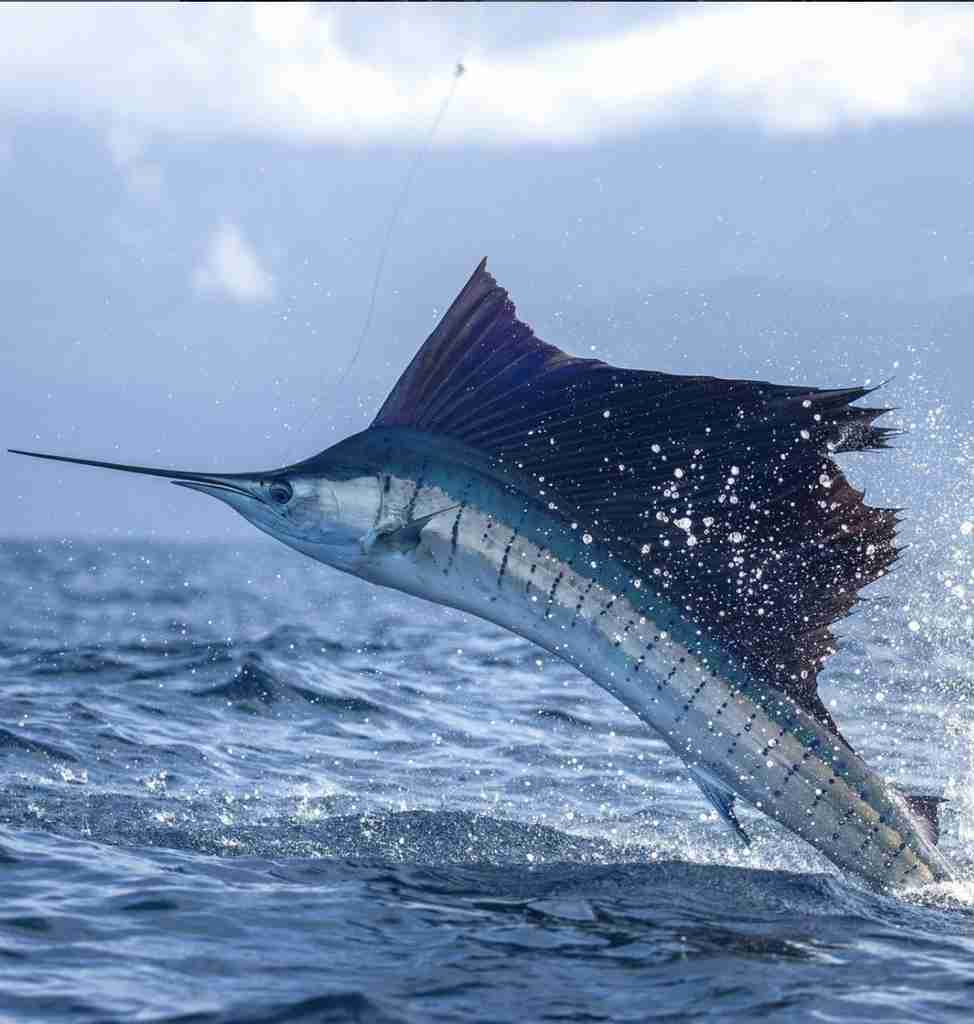
While jumping, the elongated, streamlined body and extended bill are clear indicators. The dorsal fin may be partially or fully extended, giving the fish its iconic look. Pay attention to the crescent-like pectoral and tail fins, which contrast against the bright blue water. Sunlight often reflects off the fish’s silver belly and shimmering blue back, creating a flash effect. During a jump, the sailfish may shake its head aggressively, sometimes making the bill appear curved.
Underwater
Sailfish
Underwater
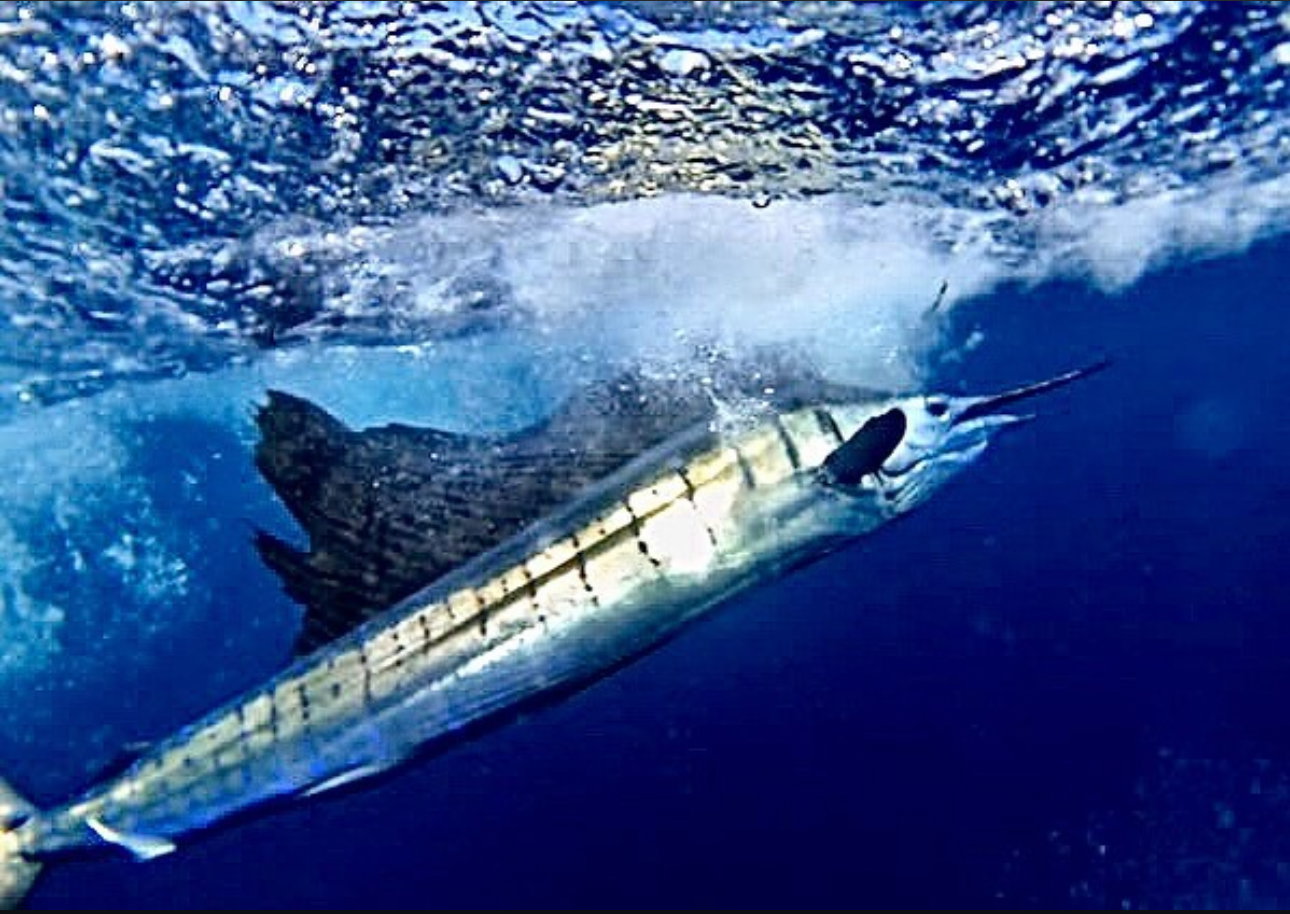
Spotting a sailfish beneath the surface requires keen observation. Their dark blue dorsal side blends with the deep ocean, while their lighter, silvery sides help them blend with sunlit water. The easiest way to identify them is by their long, slender shape and extended dorsal fin, which they often flare when excited or hunting. Watch for color changes, as sailfish are known to flash between deep blue, purple, bronze, and silver when they are active. Their fast, agile swimming style, often in groups, also sets them apart from other billfish.
Early Life
Sailfish
Early Life
Young sailfish look like miniature versions of adults but have some distinct differences. Juveniles have a relatively larger sail (dorsal fin) compared to their body size, and their bodies may appear more slender and delicate. Their coloration is often less intense, with a more pronounced silvery sheen. Their bills, though still elongated, are shorter and less developed in proportion to their body. Juveniles tend to travel in small schools, making them easier to distinguish from solitary adults.
Adult
Sailfish
Adult
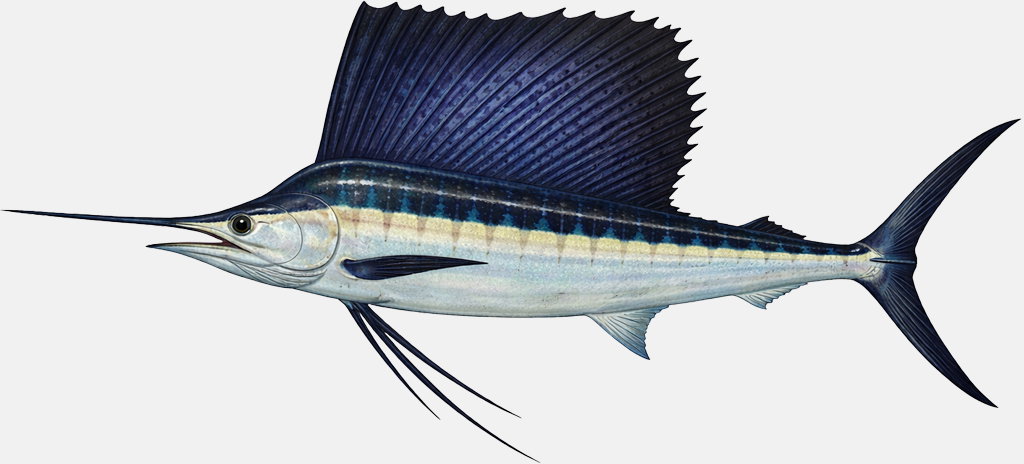
Fully grown sailfish are sleek, muscular, and built for speed. Their long, pointed bill, large dorsal fin, and slim, torpedo-shaped body make them unmistakable. They exhibit deep blue, purple, and bronze tones, with silvery flanks and vertical light blue bars. Adults can range from 6 to 11 feet in length, with most weighing between 50 and 100 pounds, though some reach up to 250 pounds. Their powerful forked tail and long pectoral fins help them move quickly through the water, often darting and changing colors when excited.
Mounted
Sailfish
Mounted
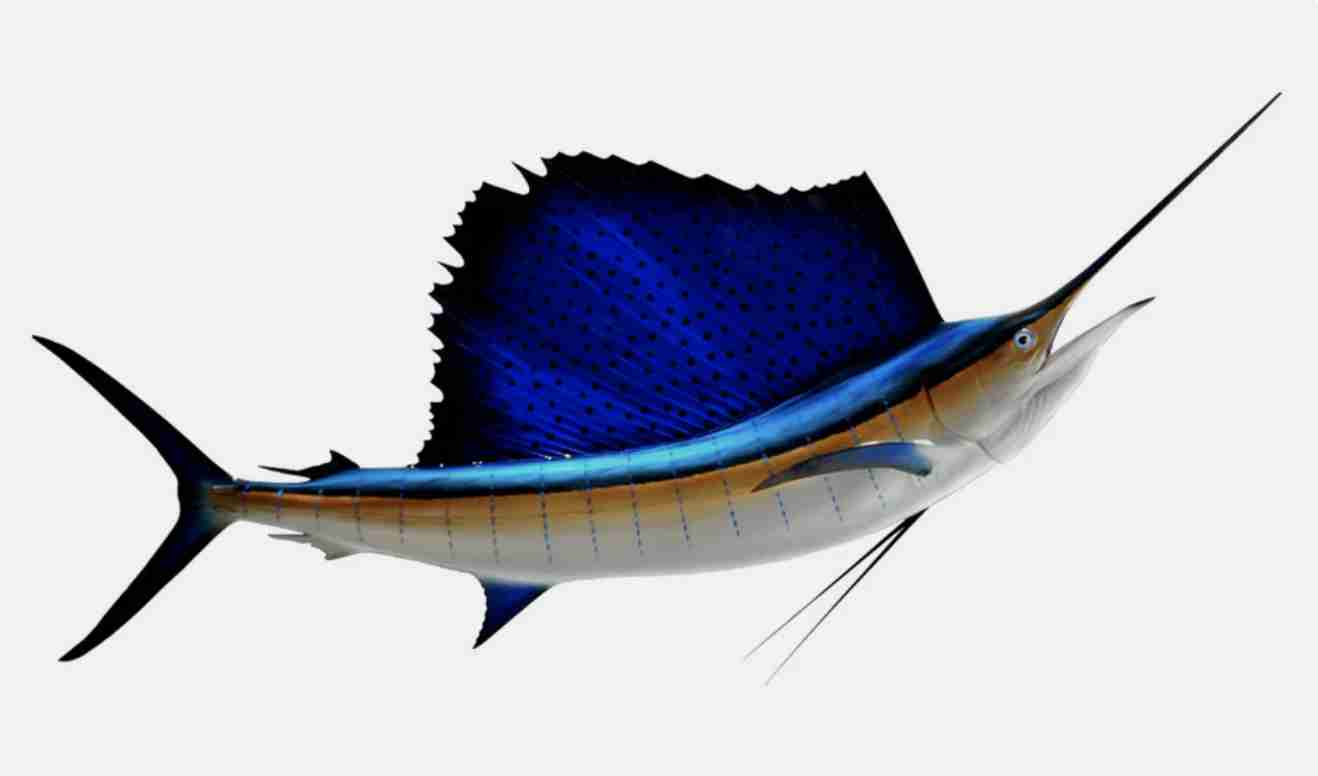
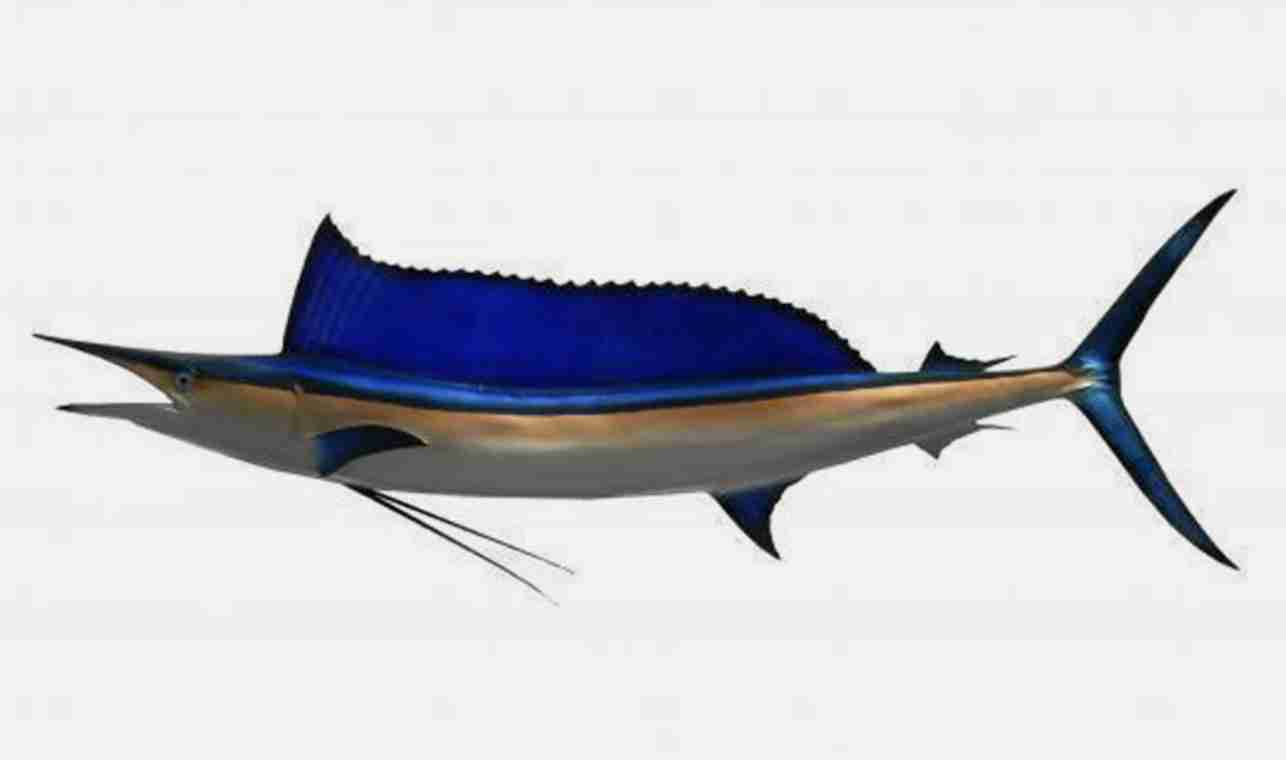
A mounted sailfish, whether real or a fiberglass replica, is often positioned with its dorsal fin fully extended to showcase its size. The coloration may be enhanced or slightly exaggerated, with deep blues and purples appearing more vibrant than in a live fish. The vertical stripes along the body are typically well-defined, and the bill is rigid and straight. Unlike a real sailfish, mounted specimens lack the color-changing ability seen in live fish, making them appear more uniform in tone.
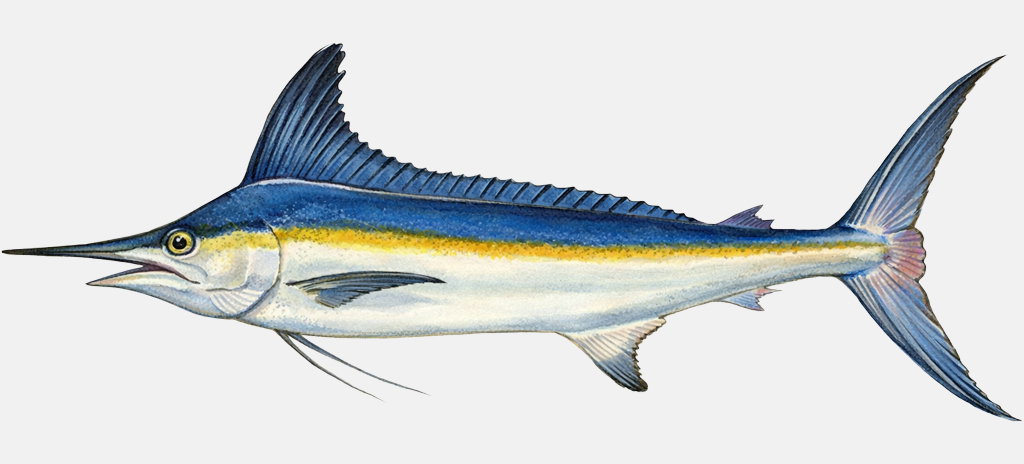
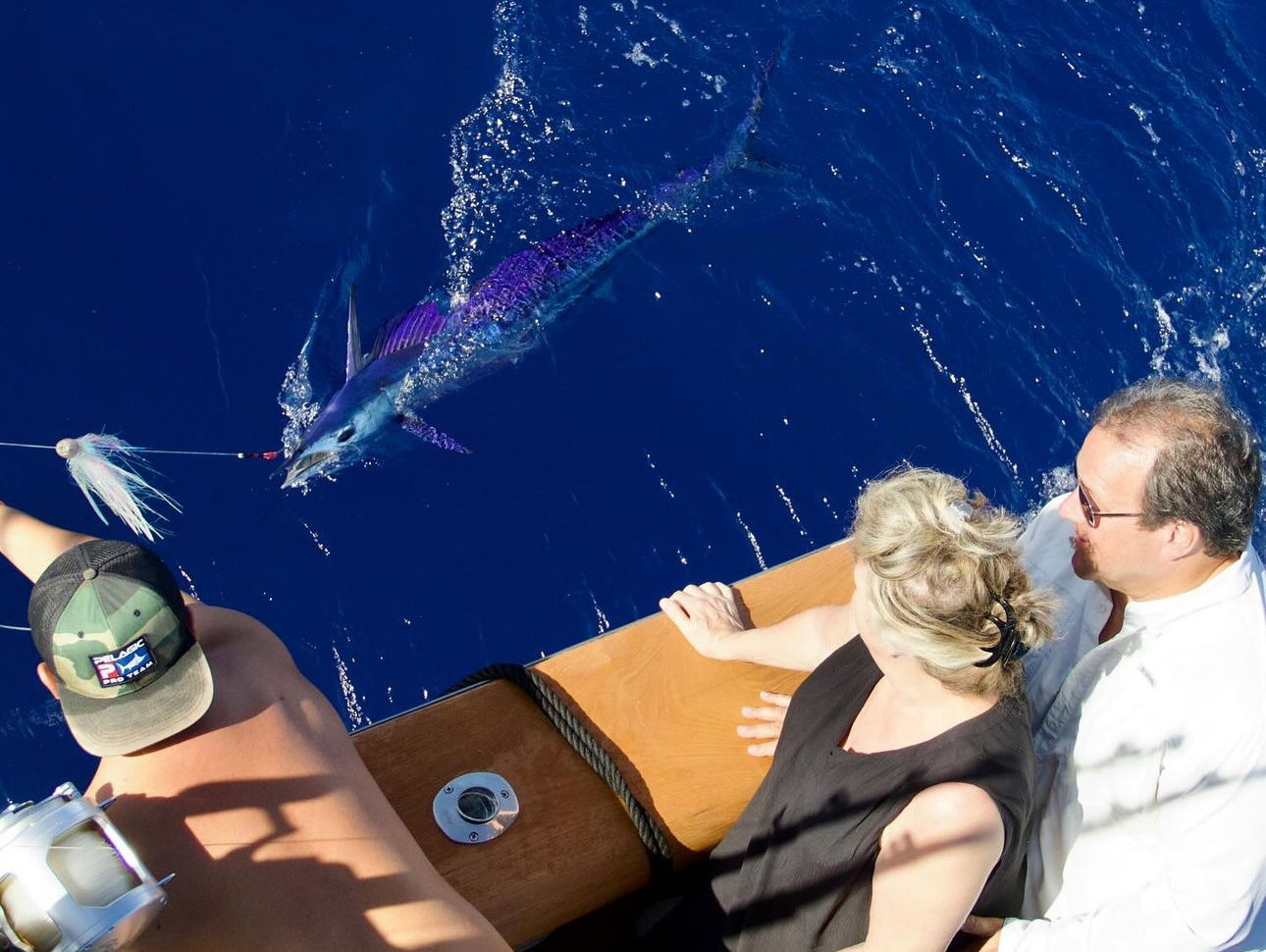
When a white marlin is brought boatside, its smaller size and slender build immediately stand out compared to other marlin species. One of the most important features to check at close range is the rounded, elongated pectoral fins, which, when pressed against the body, can reach all the way to the anal fin—this is a key distinguishing trait that separates white marlin from blues and striped marlin.
In Action
White Marlin
In Action
When a white marlin jumps, its relatively small size and sleek, acrobatic movements set it apart from larger marlin species. Their pectoral and dorsal fins are often noticeably extended, and they tend to exhibit rapid, twisting jumps with quick changes in direction. Unlike blue marlin, their jumps are often less powerful but more frequent and agile. Their bright, silvery belly flashes against the sun as they leap, and their lighter coloration helps differentiate them from darker blue marlin or sailfish.
Underwater
White Marlin
Underwater
White marlin can be tricky to spot underwater due to their lighter blue-green back, which blends well with open water. However, their rounded pectoral fins and slightly curved dorsal fin make them stand out. They often travel alone or in small groups, unlike sailfish, which are more commonly seen in larger packs. Look for faint vertical stripes along their flanks, which are often more subdued than the bold markings on sailfish. Their bill is proportionally shorter than other marlin species, and they are known for their curious nature, sometimes swimming near boats or teasers.
Early Life
White Marlin
Early Life
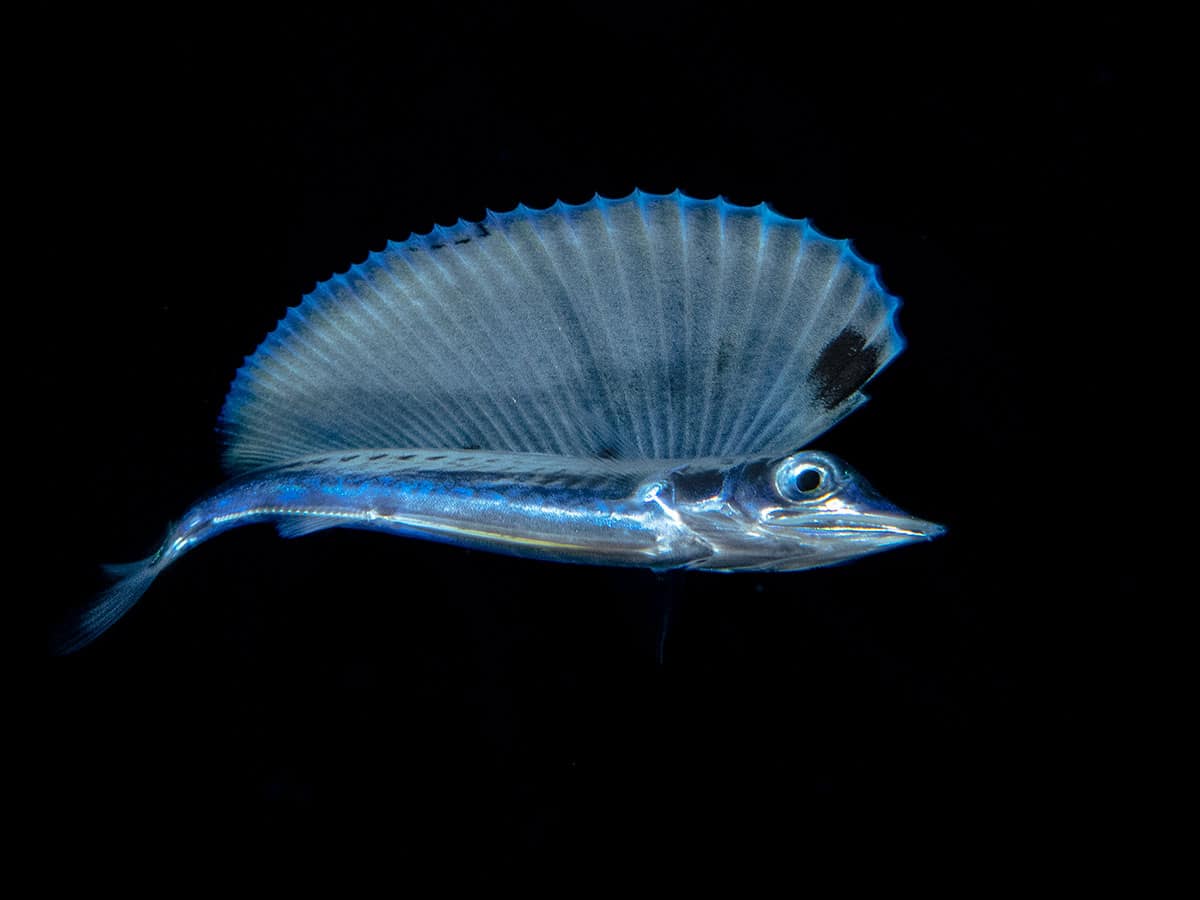
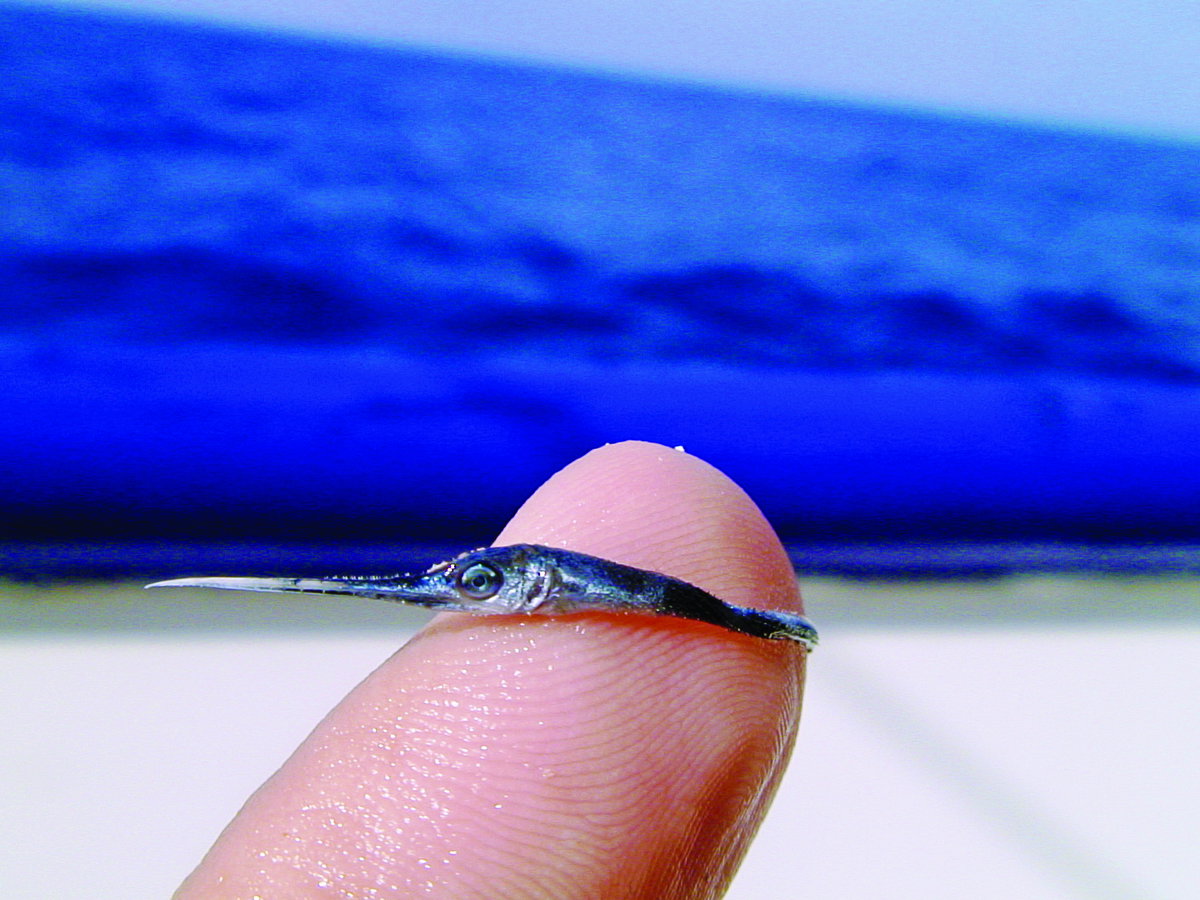
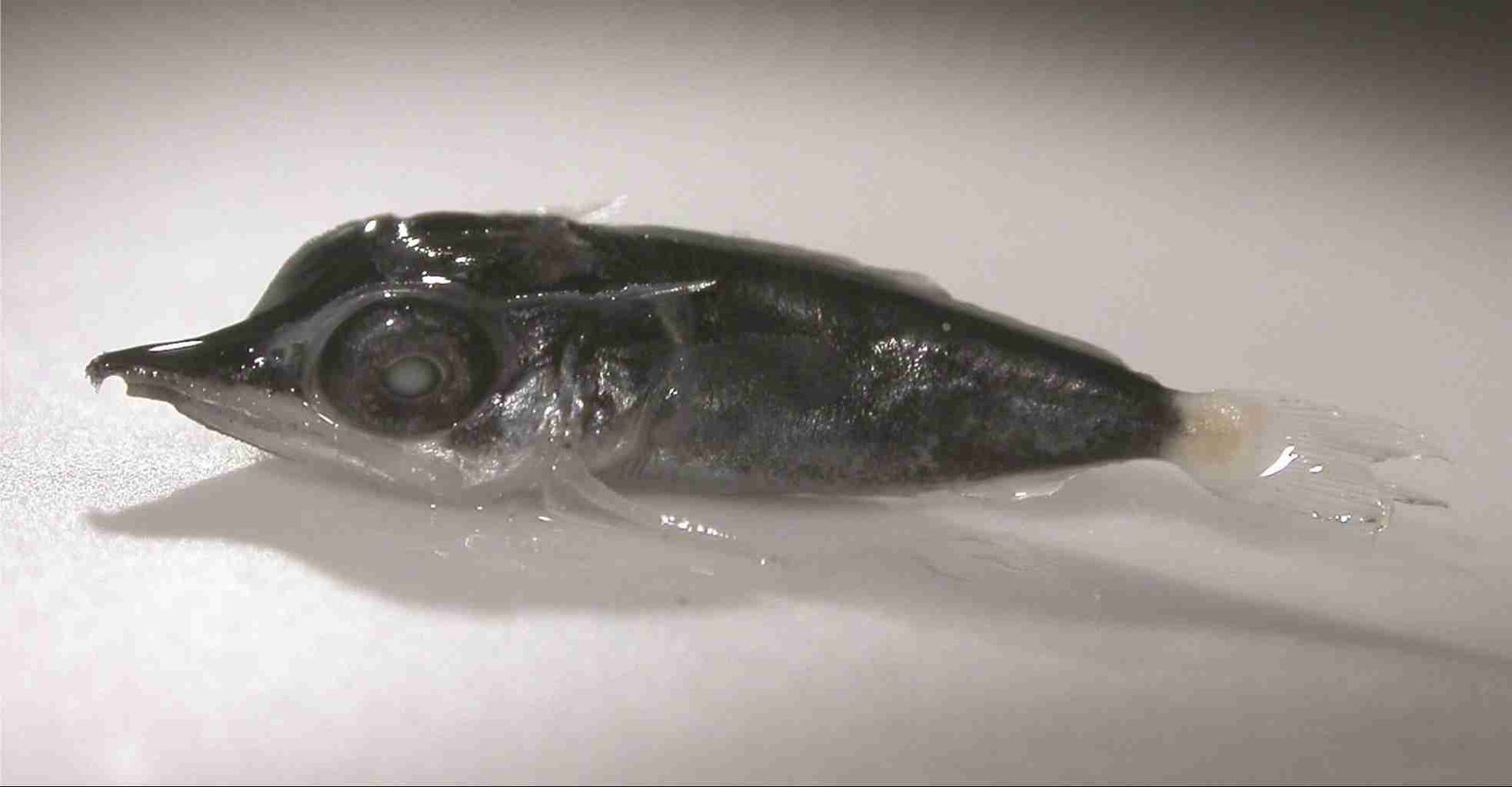
White marlin go through dramatic changes from larva to juvenile, and both stages have distinct identification traits.
In the earliest stage, white marlin larvae (like the one pictured) are tiny, translucent to dark-colored, and extremely fragile, often no longer than a few centimeters. Their most noticeable features include a large, rounded eye, a short, pointed snout, and the very early development of a bill-like extension, giving them a “miniature marlin” appearance even at this size. The fins are delicate and transparent, and the tail is deeply forked, but underdeveloped. These larvae are rarely seen by anglers but are key to understanding billfish development.
In the juvenile stage, the fish begins to resemble a scaled-down version of the adult. Juvenile white marlin have a slender, streamlined body, often with a more pronounced silver coloration than adults. The bill is still developing, but already noticeably elongated. The pectoral fins are long and rounded, and the dorsal fin is tall and curved, though not exaggerated. Young white marlin may also show visible vertical striping along the flanks, and their overall appearance is more delicate than older fish.
Juveniles are more likely to be encountered near the surface and occasionally around floating debris, often traveling in small groups. They are fast-growing, and in just a few weeks, begin to exhibit the speed and agility that define the species.
Adult
White Marlin
Adult
A fully grown white marlin typically measures 4 to 7 feet (1.2 to 2.1 meters) in length and weighs 40 to 80 pounds (18 to 36 kg), making them one of the smallest marlin species. They have a long, slender body, a moderately tall dorsal fin, and rounded, elongated pectoral fins that nearly reach the anal fin—one of the most distinguishing traits. Their coloration ranges from cobalt blue to bluish-green on top, with a silver-white belly and subtle vertical bars along the sides. Unlike blue marlin, their bill is relatively short and thin.
Mounted
White Marlin
Mounted
A mounted white marlin is often displayed with its pectoral fins extended downward and dorsal fin slightly raised, emphasizing its sleek body shape. The coloration on taxidermy or replicas may appear more vibrant, with blue-green tones exaggerated compared to a live fish. The faint vertical bars along the sides may be more pronounced in mounts, as artists often enhance these markings for visual appeal. Unlike a live fish, a mounted specimen will not show color changes, making its tone more uniform.
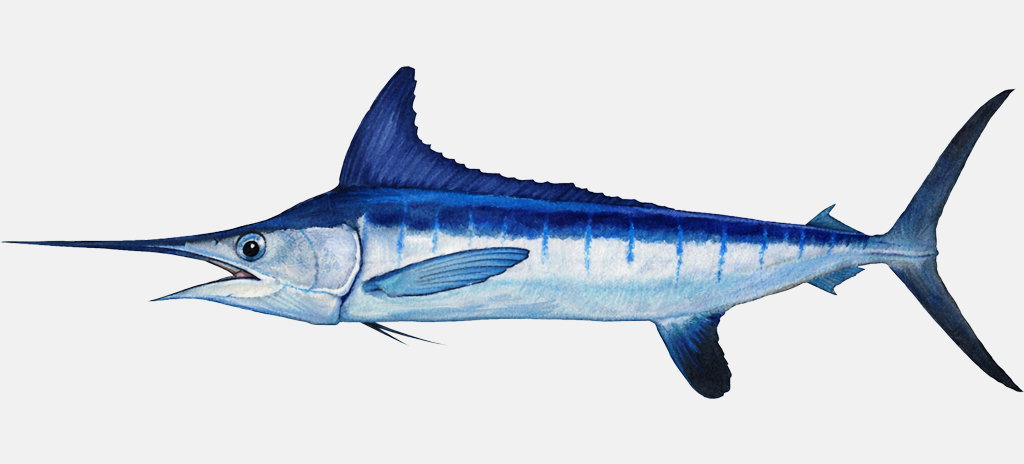
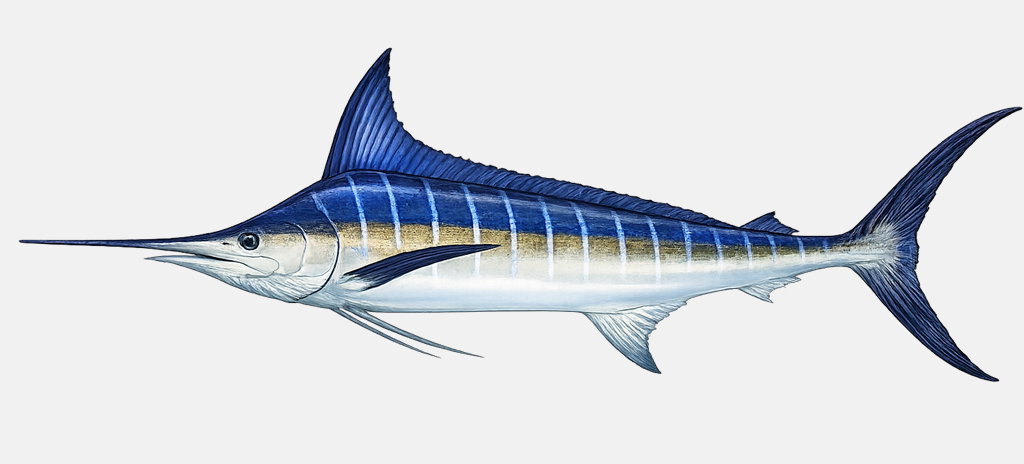
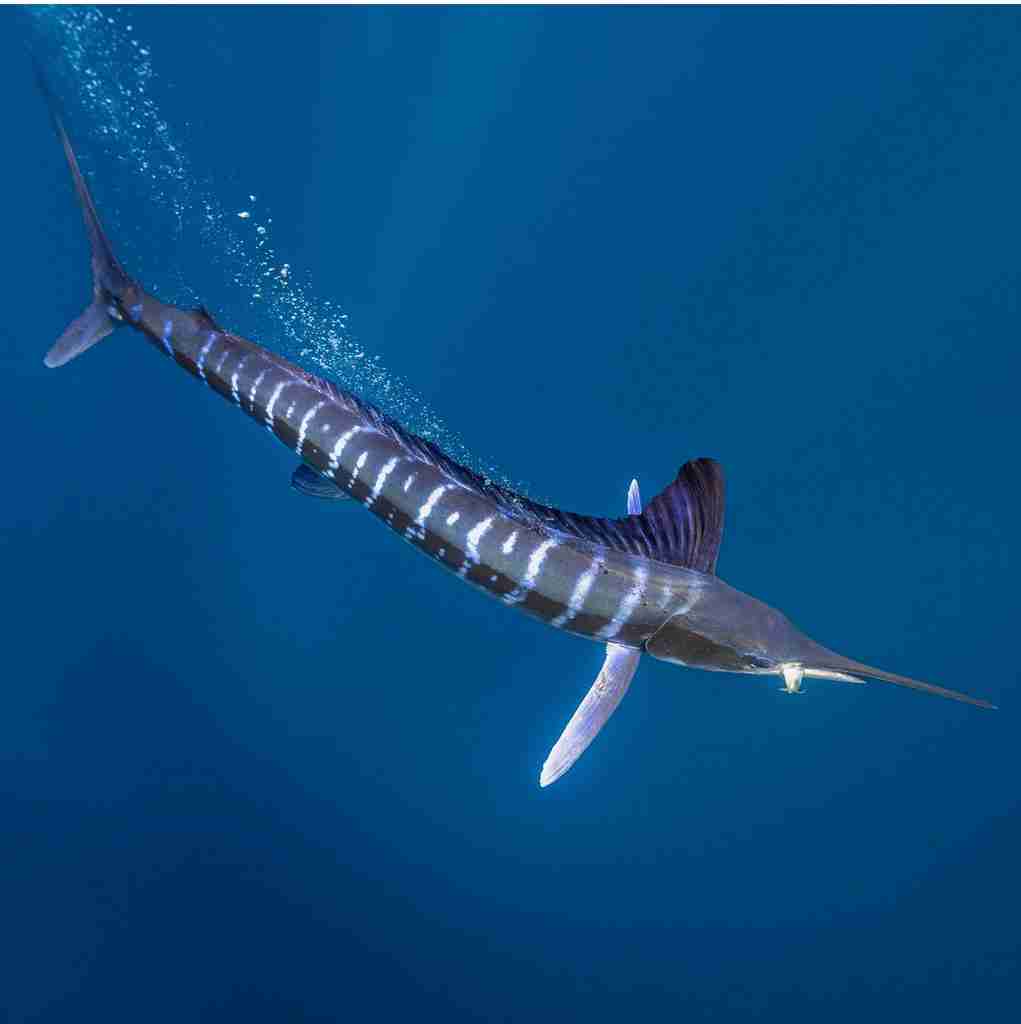
At the boat, striped marlin are often one of the most visually striking billfish species due to their vivid cobalt-blue vertical stripes, which frequently remain visible even after death. These stripes are well-defined, evenly spaced, and typically run the full length of the body. The dorsal fin is tall and sharply pointed at the front, though not as exaggerated as a sailfish’s. Unlike blue marlin, the striped marlin has a more compressed body shape and a noticeably long, slender bill.
In Action
Striped Marlin
In Action
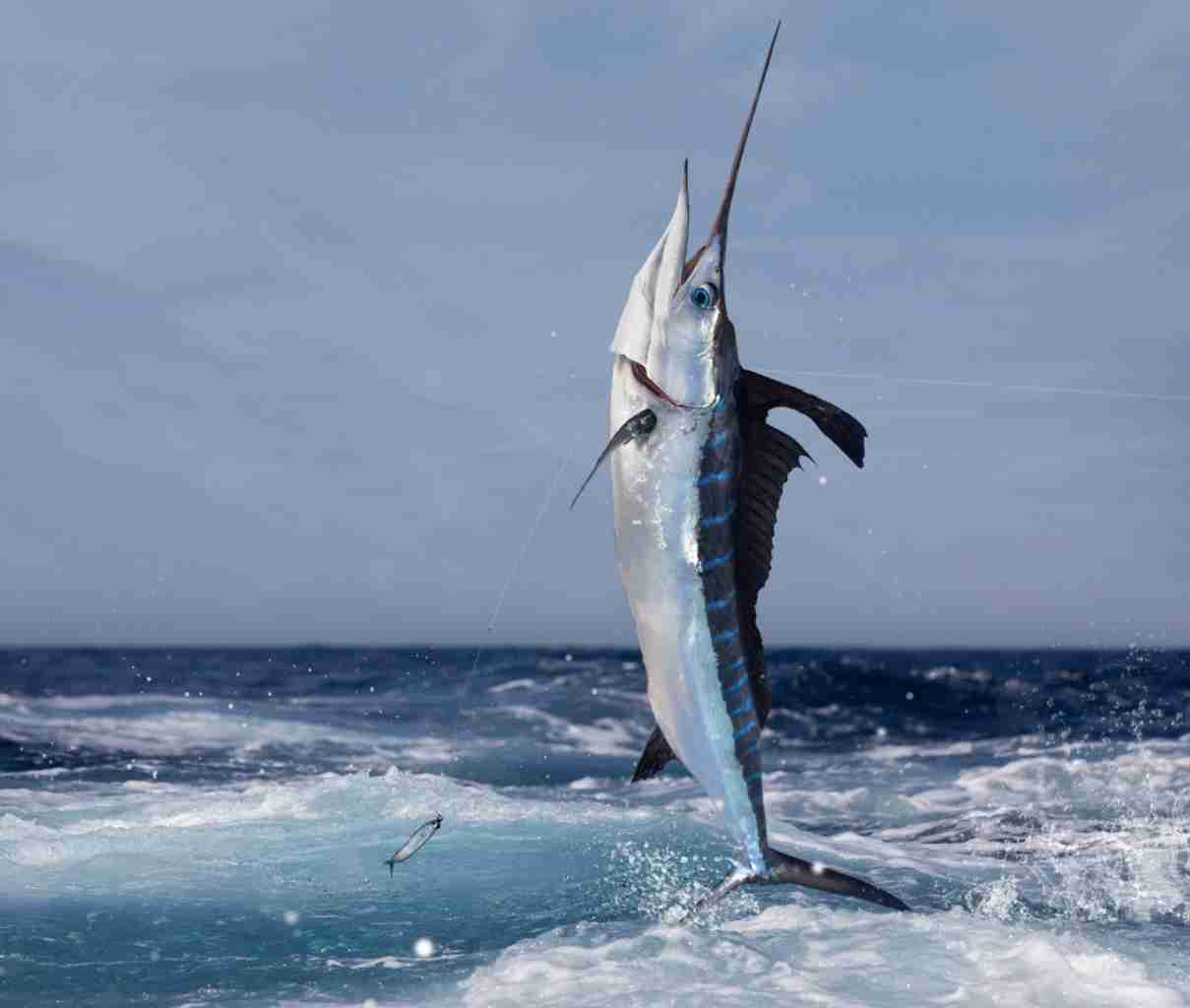
When hooked, striped marlin put on an acrobatic and aggressive display. They are known for high, repeated jumps and rapid directional changes, often slashing across the surface with speed and force. During the fight, their dorsal fin is usually raised and easy to spot, and the vertical striping may still flash above water. Compared to blue marlin, striped marlin tend to jump more frequently and are generally more visible at the surface throughout the fight.
Underwater
Striped Marlin
Underwater
Underwater, striped marlin are unmistakable when lit properly. Their electric-blue body stripes shimmer and flash with movement, making them one of the most vividly colored marlin species. Their profile is long and lean with a tall, forward-sloping dorsal fin. The stripes remain crisp and bright when the fish is lit from above or viewed in clear water, often helping distinguish them from blue marlin, which generally appear more uniform in coloration. The tail fork is deep and the body taper is more severe, giving them a sleeker appearance overall.
Early Life
Striped Marlin
Early Life
Juvenile striped marlin are difficult to identify unless you’re extremely familiar with fin ray counts or larval morphology. They may appear similar to young sailfish or even small spearfish at sea. However, striped marlin juveniles can display early vertical markings, and their dorsal fin is relatively tall even at a young age. In the wild, identification of early life stages is extremely difficult and often requires lab analysis or genetic sampling for confirmation.
Adult
Striped Marlin
Adult
Adult striped marlin have elongated, laterally compressed bodies with long, slender bills and high dorsal fins. They generally max out at smaller sizes than blue marlin, averaging 125–250 pounds, but their defining feature remains the persistent body striping, which can remain visible even after death, unlike many other billfish.
Mounted
Striped Marlin
Mounted
In mounted form, striped marlin are often easily recognized by their dramatic vertical body stripes, if the taxidermist preserved them. However, mounts may exaggerate coloration, so look for more structural traits: the high, forward-pointed dorsal fin, compressed body, and vibrant stripes. Striped marlin mounts are often mistaken for sailfish if the dorsal fin is over-extended artistically, so attention to the proportions is critical for accurate ID.
Body is slender and more cylindrical compared to other billfish
Bill is round in cross-section and less flattened than in other billfish, generally more conical in shape, with length varying by species
First dorsal fin is low and not sail-like
Pelvic fins are relatively short compared to other billfish
Lateral keels on the caudal peduncle are less pronounced than in marlin
Pectoral fins are relatively short and can be folded against the body
*Modified from Smithsonian Tropical Research Institute Fish Database.
*These characteristics represent general traits of spearfish and may vary by species. More detailed, species-specific distinctions will be provided in later sections.
Boatside
Spearfish
Boatside
Spearfish are immediately distinguishable by their smaller size and slender, torpedo-like build compared to other billfish. Boatside, they show a noticeably long, thin bill that appears proportionally longer relative to body size. Their dorsal fin is short and sharply triangular, a key feature that helps differentiate them from the taller, curved dorsal fin of a white marlin or the sail-like fin of a sailfish. The body is typically dark blue to purplish-black on top, fading to silver on the sides, and usually lacks the obvious spots or stripes seen on other species.
In Action
Spearfish
In Action
Spearfish are agile and quick, but their behavior in the fight is generally more subdued than a blue marlin. Their jumps tend to be short and close to the water, with less thrashing. They don’t have the powerful, high-flying displays of larger billfish. From a distance, they can easily be misidentified as juvenile marlin or even large mackerel species unless the bill and dorsal shape are clearly visible.
Underwater
Spearfish
Underwater
When viewed underwater, spearfish appear sleek and narrow with a clean, hydrodynamic shape. Their dorsal fin remains low and angled, not arching or elongated, and their muted coloration can make them harder to distinguish without a close look. Unlike striped marlin or sailfish, spearfish rarely exhibit strong body striping, and their overall profile is more streamlined and less bulky than a marlin.
Early Life
Spearfish
Early Life
Juvenile spearfish are extremely difficult to distinguish without close examination or lab confirmation. In the field, they may be confused with small white marlin or even sailfish. However, they tend to lack any dorsal spotting, and the fin stays relatively low even at a young age. Their early-life ID is one of the most challenging in the billfish group, especially at sea.
Adult
Spearfish
Adult
Adult spearfish are relatively small compared to other billfish, usually under 70 inches in fork length. They maintain their slim profile with long, narrow bills and low dorsal fins. Their lack of vertical stripes or distinct markings makes scale and fin structure the most reliable features for identification in this life stage.
Mounted
Spearfish
Mounted
On mounts, spearfish may be mistaken for juvenile white marlin or even striped marlin if painted with artistic liberties. Look for the telltale short, triangular dorsal fin and the proportionally long, thin bill. The body should appear lean and narrow, without the exaggerated bulk of marlin. Coloration is usually uniform with little to no striping.
Pectoral fins can not be depressed against the body
First lobe of the first dorsal fin is less than body depth
Second dorsal fin origin is in front of second anal fin origin
Double keel present
*Modified from Collette & Graves 2019
Boatside
Black Marlin
Boatside
Boatside, black marlin can be tough to distinguish from blue marlin, but several structural traits make a reliable difference when seen clearly. The most obvious is the pectoral fins since they are one of the only billfish that cannot fold their pectoral fins flat against their body. This fixed fin position is a dead giveaway. The body is thick and muscular, with a noticeably more blunt head and shorter bill than a blue marlin. The dorsal fin is lower and rounder, rising just slightly above the body without the tall, curved look of a blue marlin’s. Overall, the fish appears more compact, with a heavyset look and broad shoulders that give it a powerful presence at the surface.
In Action
Black Marlin
In Action
In a fight, black marlin can be explosive and erratic, with big, deep dives and heavy runs rather than long, repeated jumps. When they do leap, they often twist and thrash with a wide, forceful body roll rather than the quick, vertical leaps of a blue marlin. Their jumps can be more violent than graceful. Observers may notice the shorter, stubbier bill and wide pectoral fins during these breaches. They’re known for their brute power more than their speed or agility.
Underwater
Black Marlin
Underwater
When seen underwater, black marlin often look darker and more massive than other billfish. Their bodies are barrel-chested and torpedo-shaped, and they swim with powerful, deliberate motion. Unlike striped marlin or sailfish, they typically lack any visible striping or body markings, instead appearing as a deep metallic blue or nearly black along the back, fading to silver below. The rigid pectoral fins remain extended even in motion, and the dorsal fin sits low and smooth against the back. This broad, muscular silhouette sets them apart from the sleeker profile of the blue marlin underwater
Early Life
Black Marlin
Early Life
Juvenile black marlin are nearly impossible to distinguish visually in the field without lab confirmation. In early stages, they resemble small blue marlin or even white marlin, depending on size and region. However, they tend to have deeper bodies and the same stubby, heavyset profile as adults, just scaled down. Fin position and body shape may offer clues, but early life identification is best left to experts with genetic or meristic data.
Adult
Black Marlin
Adult
Adult black marlin are some of the largest billfish in the ocean, reaching over 1,000 pounds in some regions. Unlike blue marlin, their pectoral fins are permanently extended, and the dorsal fin is relatively short and rounded. The bill is thick and conical, not as long or slender as that of a blue marlin. The fish’s coloration is darker overall, with a more uniform dark-blue to blackish tone along the top of the body and no vertical stripes. The body is heavy and deep, especially near the head and shoulders, giving them a more “bulldog” look compared to the sleeker, more elongated profile of blue marlin.
Mounted
Black Marlin
Mounted
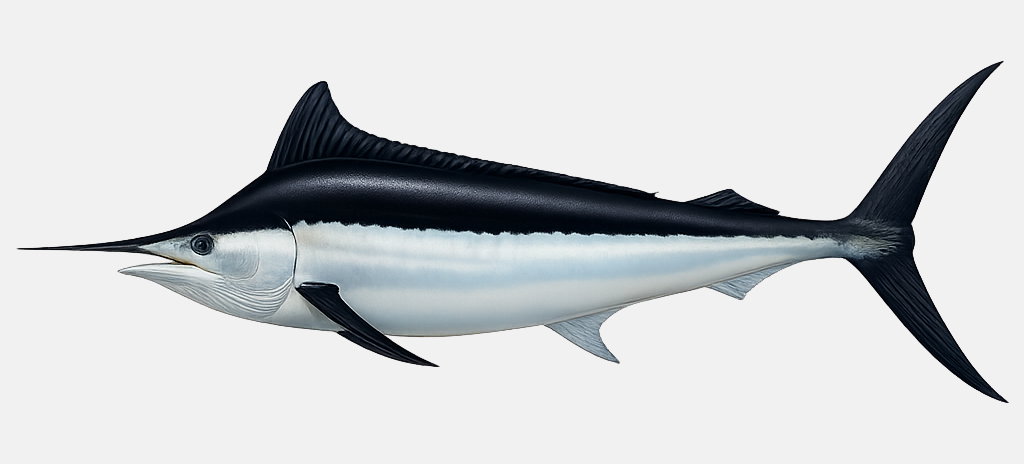
Black marlin mounts often exaggerate the size and posture of the fish, but a few reliable indicators hold. The fixed pectoral fins (set at an outward angle), rounded dorsal, and shorter, blunter bill help set black marlin apart from similar-looking blue marlin mounts. If the fish is mounted with bright blue striping, it’s almost certainly a blue marlin since black marlin should have a solid, darker tone throughout. Their mounts tend to appear bulkier and more “stocky” than other species, especially through the midsection.
There are seven main categories of billfish, with an additional five subspecies. They’re found all across the world, ranging in size from a few feet to more than 15 feet! Click on a species below to learn more about them.
Not sure what you’ve caught? Our team can help. Share your photos or details, and we’ll work with you to accurately identify the species and provide any additional insight.
If you’d like to see your photos spotlighted in one of TBF’s publications or online via social media, then send them our way! We are always looking for high resolution photos of billfish in the water or jumping. Click below for more information on how to submit your pictures.
TBF collects and utilizes data for advancing responsible fisheries management and billfish conservation, highlighting the importance of the recreational fishing community.